
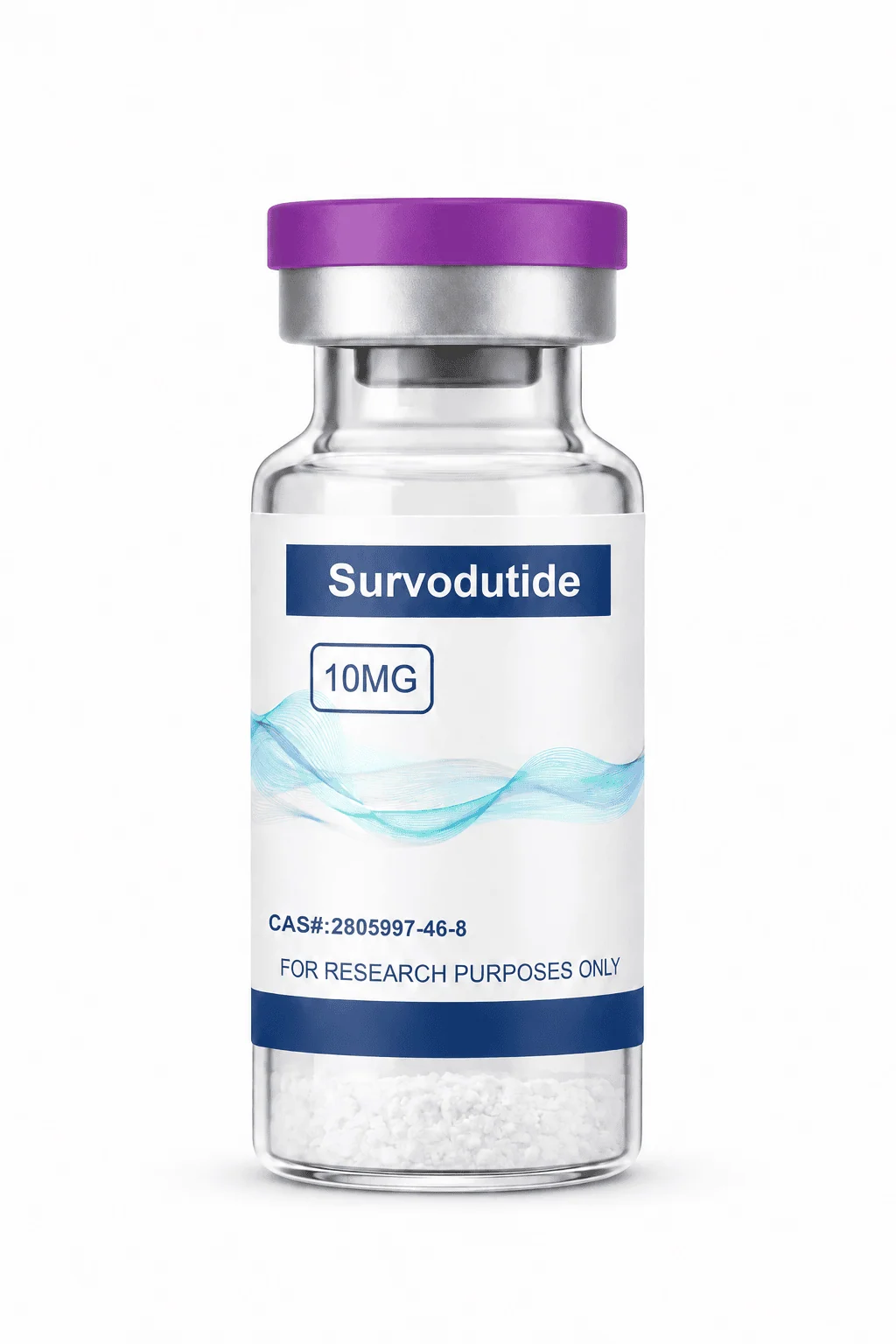
Code BI 456906
CAS# 2805997-46-8
Class Long-Acting Dual GLP-1R / GCGR Agonist (Glucagon-Based Scaffold)
Form Lyophilized Powder
Dual Receptor Targets
Peptide Length
Molecular Weight
Survodutide (INN; code BI 456906; Boehringer Ingelheim) is a long-acting, fatty acid–conjugated dual agonist of GLP-1 receptors (GLP-1R) and glucagon receptors (GCGR) built on a modified glucagon peptide scaffold. Unlike oxyntomodulin-based dual agonists such as mazdutide — which derive their dual receptor activity from the natural GLP-1R/GCGR promiscuity of the 37-AA OXM proglucagon fragment — survodutide engineers GLP-1R potency directly into a shorter glucagon-derived backbone through targeted amino acid substitutions, enabling a pharmacologically distinct receptor engagement profile in vitro. Both receptor subtypes signal primarily via Gαs → adenylyl cyclase → cAMP, but their tissue distribution and downstream metabolic effects differ critically: GLP-1R activation drives pancreatic insulin secretion, hypothalamic satiety signalling, and gastric emptying inhibition, while GCGR activation stimulates hepatic fatty acid β-oxidation, suppresses hepatic lipogenesis, and upregulates thermogenic pathways — making GCGR engagement a subject of strong research interest in models of hepatic steatosis and metabolic dysfunction-associated steatohepatitis (MASH). Survodutide has been applied in preclinical and clinical models encompassing liver histology endpoints, glycaemic modulation, and body weight regulation, distinguishing it from GLP-1R–selective tools by the addition of a direct hepatic lipid axis.
Molecular Profile
structural class · scaffold origin · receptor targets · key modifications
structural class · scaffold origin · receptor targets · key modifications
| Property | Detail |
|---|---|
| INN / Code Name | Survodutide; BI 456906 |
| CAS Number | 2805997-46-8 |
| Developer | Boehringer Ingelheim |
| Structural Class | Modified Glucagon Peptide Analogue — Dual GLP-1R/GCGR Agonist, Fatty Acid Conjugated |
| Native Scaffold | Human glucagon: HSQGTFTSDYSKYLDSRRAQDFVQWLMNT · 29 AA · ~3,485 Da · t½ ~3–6 min |
| Molecular Weight | ~4,300 Da (approximate; includes FA conjugate; refer to Certificate of Analysis) |
| Backbone Length | ~29 AA (glucagon scaffold with GLP-1R–activating substitutions) |
| Primary Receptors | GLP-1R (Class B GPCR, Gαs) + GCGR (Class B GPCR, Gαs) |
| Receptor Class | Class B Family B GPCRs; GLP-1R and GCGR share ~40–45% sequence identity |
| GLP-1R Modifications | Targeted backbone substitutions at positions critical for GLP-1R engagement — absent from native glucagon — confer full GLP-1R agonism on a glucagon-based scaffold |
| PK Extension | Fatty acid conjugate via linker at Lys side chain; reversible albumin binding for once-weekly half-life (~7 days) |
| Terminus | Free N-terminus (His¹); C-terminal amide |
| Native Comparator | Mazdutide (IBI362): OXM-based 37 AA dual GLP-1R/GCGR agonist — distinct molecular scaffold with GCGR activity arising from OXM’s C-terminal octapeptide extension |
In Vitro Research Context
glucagon scaffold · hepatic GCGR axis · GLP-1R/GCGR co-agonism · MASH models
glucagon scaffold · hepatic GCGR axis · GLP-1R/GCGR co-agonism · MASH models
Survodutide’s glucagon-based scaffold confers inherent, high-affinity GCGR engagement — the native receptor for glucagon — while GLP-1R activity is engineered in through specific backbone substitutions that introduce amino acid identities shared with GLP-1 at receptor-contact positions. This design contrasts with the oxyntomodulin (OXM)-based approach of mazdutide, where dual receptor activity emerges from the natural dual-ligand character of the full 37 AA proglucagon-derived OXM sequence. The practical consequence in cell-based research is a defined, glucagon-like GCGR engagement profile that drives hepatic pathways particularly relevant to steatosis models: GCGR → Gαs → cAMP → PKA signalling in hepatocytes has been linked to upregulation of peroxisome proliferator-activated receptor α (PPARα), promotion of mitochondrial fatty acid β-oxidation, suppression of de novo lipogenesis (DNL) via sterol regulatory element-binding protein 1c (SREBP-1c) downregulation, and mobilisation of intrahepatic triglyceride stores. These mechanisms have made GCGR agonism a research focus in metabolic dysfunction-associated steatohepatitis (MASH) models — contexts where the pure GLP-1R agonism of semaglutide addresses adiposity but does not directly target the hepatocyte lipid machinery at the level survodutide’s GCGR axis can. A fatty acid conjugate analogous to semaglutide’s C18 diacid extends the plasma half-life to approximately seven days for once-weekly chronic research dosing paradigms.
GLP-1R / GCGR agonist landscape — scaffold and hepatic research context:
| Peptide | GLP-1R | GCGR | Scaffold | Key Research Context |
|---|---|---|---|---|
| Native Glucagon | Low partial | Full agonist | 29 AA | Hepatic glucose production; lipolysis |
| Semaglutide | Full agonist | Inactive | 31 AA (modified) | GLP-1R–selective; no direct hepatic GCGR axis |
| Mazdutide (IBI362) | Full agonist | Full agonist | OXM 37 AA | Dual agonism via OXM scaffold; balanced receptor ratio |
| Survodutide ★ (BI 456906) | Full agonist | Full agonist | Glucagon 29 AA | Dual agonism via glucagon scaffold; MASH/hepatic lipid axis |
Competitive radioligand displacement at GLP-1R and GCGR; cAMP accumulation EC₅₀ profiling at each receptor; receptor selectivity ratio characterisation; β-arrestin recruitment and internalisation assays; comparison with mazdutide in same receptor system.
GCGR-mediated hepatocyte cAMP/PPARα activation; de novo lipogenesis suppression assays (SREBP-1c/FAS expression); mitochondrial fatty acid β-oxidation flux studies; intrahepatic triglyceride quantification models; fibrosis pathway (TGF-β/α-SMA) studies in stellate cell models.
Gαs → adenylyl cyclase → cAMP → PKA activation at GLP-1R (pancreatic beta cells, enteroendocrine models) and GCGR (hepatocyte models); CREB phosphorylation assays; downstream gluconeogenesis gene expression (PEPCK, G6Pase) profiling.
GLP-1R–mediated hypothalamic satiety circuit studies (NPY/AgRP/POMC); GCGR thermogenic pathway models in brown adipose tissue; insulin secretion assays in beta-cell lines; glucagon suppression and alpha-cell modulation studies.
Available Formats
vial sizes · physical form · purity specification
vial sizes · physical form · purity specification
| Format | Amount | Physical Form | Purity | Storage |
|---|---|---|---|---|
| Survodutide | 10 mg | Lyophilised powder | ≥98% | −20 °C |
Purity verification: Each batch is characterised by HPLC and mass spectrometry. Certificate of Analysis — including confirmed CAS number, exact molecular weight, and sequence verification — available upon request. Confirm all specifications against CoA prior to research use.
Laboratory Storage
lyophilised · reconstituted · scaffold-specific stability
lyophilised · reconstituted · scaffold-specific stability
| Condition | Guidance |
|---|---|
| Long-Term (Lyophilised) | −20 °C or below, desiccated, protected from light; stable for ≥24 months under recommended conditions |
| Short-Term (Lyophilised) | 4 °C for up to 4 weeks; minimise temperature cycling |
| Reconstituted Solutions | Store at −20 °C in single-use aliquots; avoid repeated freeze-thaw cycles which promote C18-mediated aggregation |
| Trp²⁵ Photooxidation | Native glucagon Trp²⁵ is a known photooxidation liability; confirm with CoA whether survodutide retains Trp at this position or incorporates a stabilising substitution; protect reconstituted solutions from UV and high-intensity light regardless |
| Met²⁷ Oxidation | Native glucagon Met²⁷ is oxidation-prone; survodutide modifications may substitute or retain this residue — consult CoA; use degassed vehicles and avoid peroxide-containing buffers as a standard precaution |
| No Disulfide Bridge | Glucagon backbone contains no Cys — no disulfide oxidation risk; simplifies redox-sensitive assay buffer selection |
| Fatty Acid Conjugate | C18-type chain is hydrolytically stable at neutral pH; avoid strongly acidic/basic conditions (pH <4 or >9); conjugate promotes aggregation at concentrations >2 mg/mL in low ionic-strength buffers |
Reconstitution vehicle: PBS (pH 7.4) with 0.01–0.05% polysorbate 20 is recommended to minimise surface adsorption of the fatty acid–conjugated peptide and suppress aggregation. Use siliconised tubes at low working concentrations (sub-100 nM) where adsorptive losses would otherwise affect dose accuracy.
Research Literature
selected references · survodutide clinical data · GCGR hepatic pharmacology · MASH
selected references · survodutide clinical data · GCGR hepatic pharmacology · MASH
Hartman et al. (2024) — Survodutide (BI 456906) in a phase 2 trial for non-alcoholic steatohepatitis / MASH: dose-dependent liver histology outcomes. NEJM Evidence. PMID: 38272075. Primary clinical pharmacology characterisation of survodutide’s dual GLP-1R/GCGR receptor engagement and hepatic endpoint data.
Pocai et al. (2009) — Glucagon-like peptide 1/glucagon receptor dual agonism reverses obesity in mice. Diabetes. PMID: 19543232. Foundational preclinical proof-of-concept establishing the dual GLP-1R/GCGR agonism strategy that underpins the survodutide pharmacological rationale.
Longuet et al. (2008) / Baggio & Drucker review — Glucagon receptor signalling and hepatic lipid metabolism: PPARα, SREBP-1c, and fatty acid β-oxidation pathway characterisation relevant to the GCGR-mediated hepatic axis of survodutide. See also Baggio & Drucker 2007 (PMID: 17606895) for GLP-1R pharmacology context.
Survodutide supplied by NexPept is intended exclusively for in vitro laboratory research and preclinical investigation. This material is not approved for human or veterinary administration in Canada or any other jurisdiction and does not constitute a drug product, natural health product, or therapeutic agent.
Researchers are responsible for ensuring all use complies with applicable institutional biosafety protocols, ethics board requirements, and federal regulations. For full product specifications, analytical data, and batch documentation, refer to the Certificate of Analysis provided with each order.
Product page: nexpept.ca — Survodutide Research Peptide Overview
Be the first to review “SURVODUTIDE 10MG”
Related products
Reviews
There are no reviews yet.