HPLC + MS
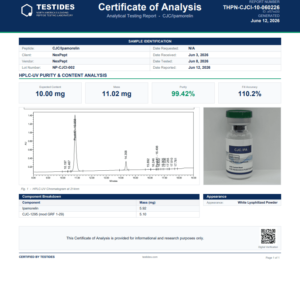
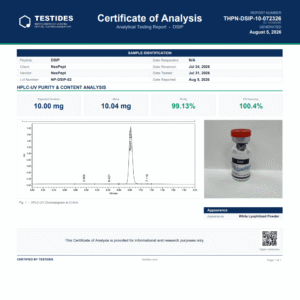
Independently tested for identity and purity
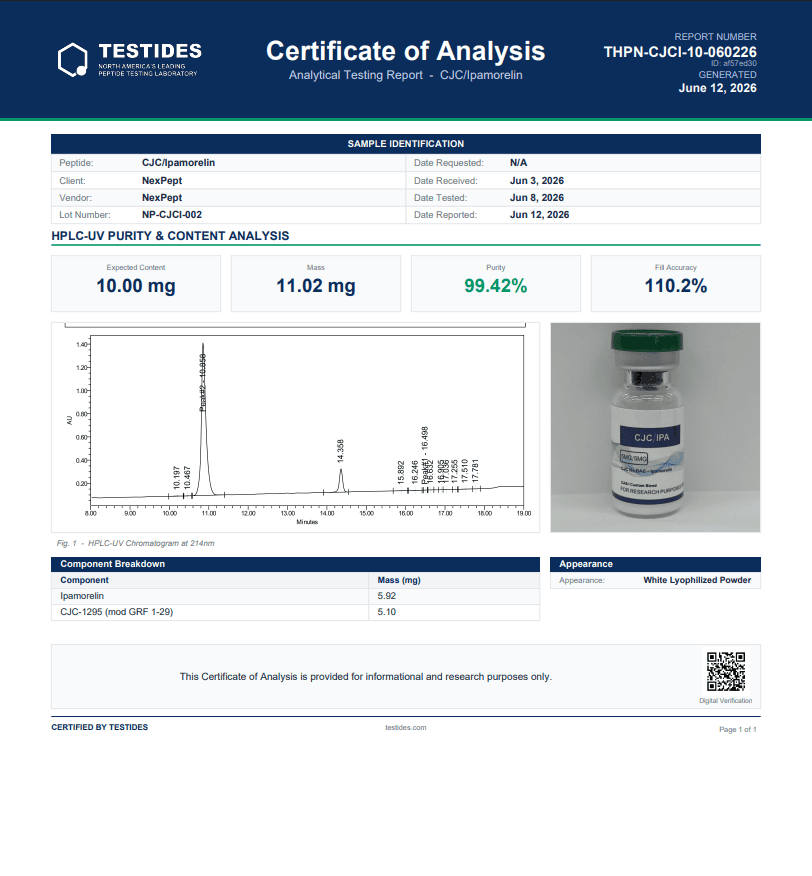
NP-CJCI-002
Jun 12, 2026
99.42%
View Certificate of Analysis
CAS# 863288-34-0 / 170851-70-4
Targets GHRHR + GHSR-1a
Class Dual-Component GH Axis Research Blend
Form Lyophilized Powder
Receptor Targets
Per Component
Total per Vial
CJC-1295 No DAC
Also: Mod GRF(1-29) · CAS# 863288-34-0
29 AA · GHRHR Agonist
Ipamorelin
Also: NNC 26-0161 · CAS# 170851-70-4
5 AA · GHSR-1a Agonist · 711.9 Da
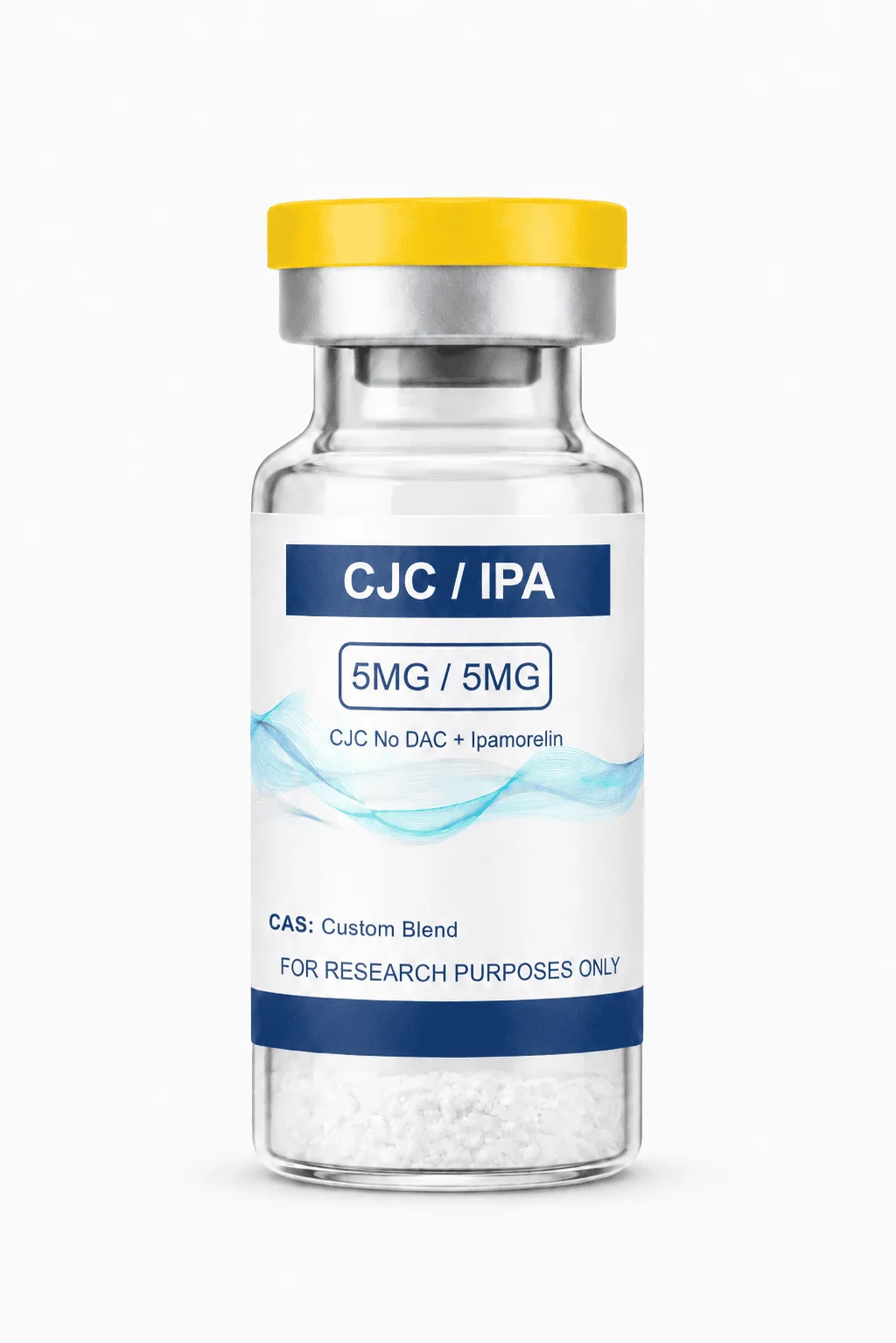
The CJC-1295 No DAC / Ipamorelin blend is a dual-component lyophilized research formulation combining two structurally distinct synthetic peptides that act on separate receptors within the hypothalamic-pituitary somatotropic axis. CJC-1295 No DAC (Mod GRF 1-29, CAS# 863288-34-0) is a modified 29-amino-acid GHRH analogue that binds the growth hormone releasing hormone receptor (GHRHR), while Ipamorelin (NNC 26-0161, CAS# 170851-70-4) is a selective synthetic pentapeptide that binds the growth hormone secretagogue receptor type 1a (GHSR-1a). Each vial contains 5mg of each component for 10mg total. Supplied by NexPept as a lyophilized powder for in vitro laboratory research use. Neither component has been authorized by Health Canada for any therapeutic, clinical, or human use.
Molecular Profile
CAS#, sequence lengths, molecular weights, analytical data
CAS#, sequence lengths, molecular weights, analytical data
Component 1 — CJC-1295 No DAC (Mod GRF 1-29)
| Property | Value |
|---|---|
| CAS Number | 863288-34-0 |
| Research Designation | Mod GRF(1-29); Modified GRF(1-29) |
| Compound Class | Synthetic 29-AA GHRH analogue — GHRHR agonist |
| Sequence Length | 29 amino acids |
| Molecular Weight | ~3367.9 Da |
| Receptor Target | GHRHR (Growth Hormone Releasing Hormone Receptor) |
| Key Structural Note | Absence of Drug Affinity Complex (DAC) — shorter signalling duration than CJC-1295 with DAC |
| Quantity per Vial | 5 mg |
Component 2 — Ipamorelin
| Property | Value |
|---|---|
| CAS Number | 170851-70-4 |
| Research Designation | NNC 26-0161 |
| Compound Class | Synthetic pentapeptide — selective GHSR-1a agonist |
| Sequence Length | 5 amino acids |
| Molecular Weight | 711.86 Da |
| Receptor Target | GHSR-1a (Growth Hormone Secretagogue Receptor type 1a) |
| Selectivity Profile | Selective — does not significantly bind cortisol or prolactin pathways in vitro |
| Quantity per Vial | 5 mg |
Blend specification: Both components are co-lyophilized in a single vial. Total peptide content is 10mg (5mg CJC-1295 No DAC + 5mg Ipamorelin). Purity verified by HPLC and Mass Spectrometry for each component batch.
In Vitro Research Context
Dual-receptor pharmacology — laboratory use only
Dual-receptor pharmacology — laboratory use only
GHRHR — Growth Hormone Releasing Hormone Receptor
A G protein-coupled receptor activated by endogenous GHRH. CJC-1295 No DAC (Mod GRF 1-29) is a modified 29-AA GHRH fragment studied for GHRHR binding kinetics and downstream cAMP/PKA signalling cascades in pituitary cell models. The absence of the Drug Affinity Complex (DAC) distinguishes this compound from long-acting CJC-1295, making it useful for studying shorter-duration GHRHR signalling windows.
GHSR-1a — Growth Hormone Secretagogue Receptor Type 1a
A G protein-coupled receptor involved in endocrine signalling regulation. Ipamorelin is studied as a selective GHSR-1a agonist in receptor binding assays and secretagogue pathway models. Its defined selectivity profile — not significantly binding cortisol or prolactin pathways in vitro — makes it a precise pharmacological tool for isolating GHSR-1a-specific signalling in dual-receptor study designs.
This blend is studied in preclinical in vitro settings for its dual-receptor pharmacology within the somatotropic axis. CJC-1295 No DAC and Ipamorelin target distinct receptor classes — GHRHR and GHSR-1a respectively — providing a research model for examining convergent and independent signalling pathways in GH axis research without receptor cross-reactivity. The combination is used in comparative and combination pharmacology studies to delineate receptor-specific contributions to downstream signalling events.
Research context: This is a dual-component investigational peptide blend studied for its receptor pharmacology in somatotropic axis signalling models. Neither component has been authorized by Health Canada for human or veterinary use.
Available Formats
5mg / 5mg blend — 10mg total, lyophilized powder
5mg / 5mg blend — 10mg total, lyophilized powder
| Component | Quantity | Physical Form |
|---|---|---|
| CJC-1295 No DAC | 5 mg / vial | Lyophilized powder (co-lyophilized blend) |
| Ipamorelin | 5 mg / vial | Lyophilized powder (co-lyophilized blend) |
| Total per Vial | 10 mg | — |
Sourced from a verified batch. Quantity for use should be determined based on your specific in vitro research protocol by qualified research personnel.
Laboratory Storage
Controlled storage conditions for lyophilized blend
Controlled storage conditions for lyophilized blend
Store sealed lyophilized blend material under controlled laboratory conditions in accordance with validated institutional SOPs and applicable technical documentation. Protect from light and moisture. As a co-lyophilized multi-peptide blend, storage conditions should account for the stability requirements of both components. Handling conditions should be established by qualified research personnel in accordance with the specific experimental protocol.
Note: No preparation, reconstitution, or administration instructions are provided. This compound is supplied for in vitro laboratory research use only. All handling must be conducted by qualified personnel following institutional safety protocols.
Research Literature
Scientific references & related resources
Scientific references & related resources
Ipamorelin + CJC-1295 No DAC Research Guide — NexPept dual-compound overview and in vitro research context
PubMed — CJC-1295 No DAC / Mod GRF(1-29) — peer-reviewed literature on GHRHR signalling and GHRH analogues
PubMed — Ipamorelin / NNC 26-0161 — peer-reviewed literature on GHSR-1a pharmacology
Research Peptides in Canada — sourcing and research context for Canadian laboratories
What Are Research Peptides? — peptide classification and in vitro research context
This product is supplied exclusively for in vitro laboratory and non-clinical research use by qualified research personnel. Neither component is authorized by Health Canada for human or veterinary use. No therapeutic, clinical, or health claims are made.
This material must not be administered to humans or animals. No dosage, preparation, reconstitution, or administration instructions are provided or implied. All handling and use must be conducted by qualified personnel in accordance with applicable institutional policies and legal requirements.
Be the first to review “CJC-1295 no DAC + Ipamorelin Blend”
Related products
Reviews
There are no reviews yet.