
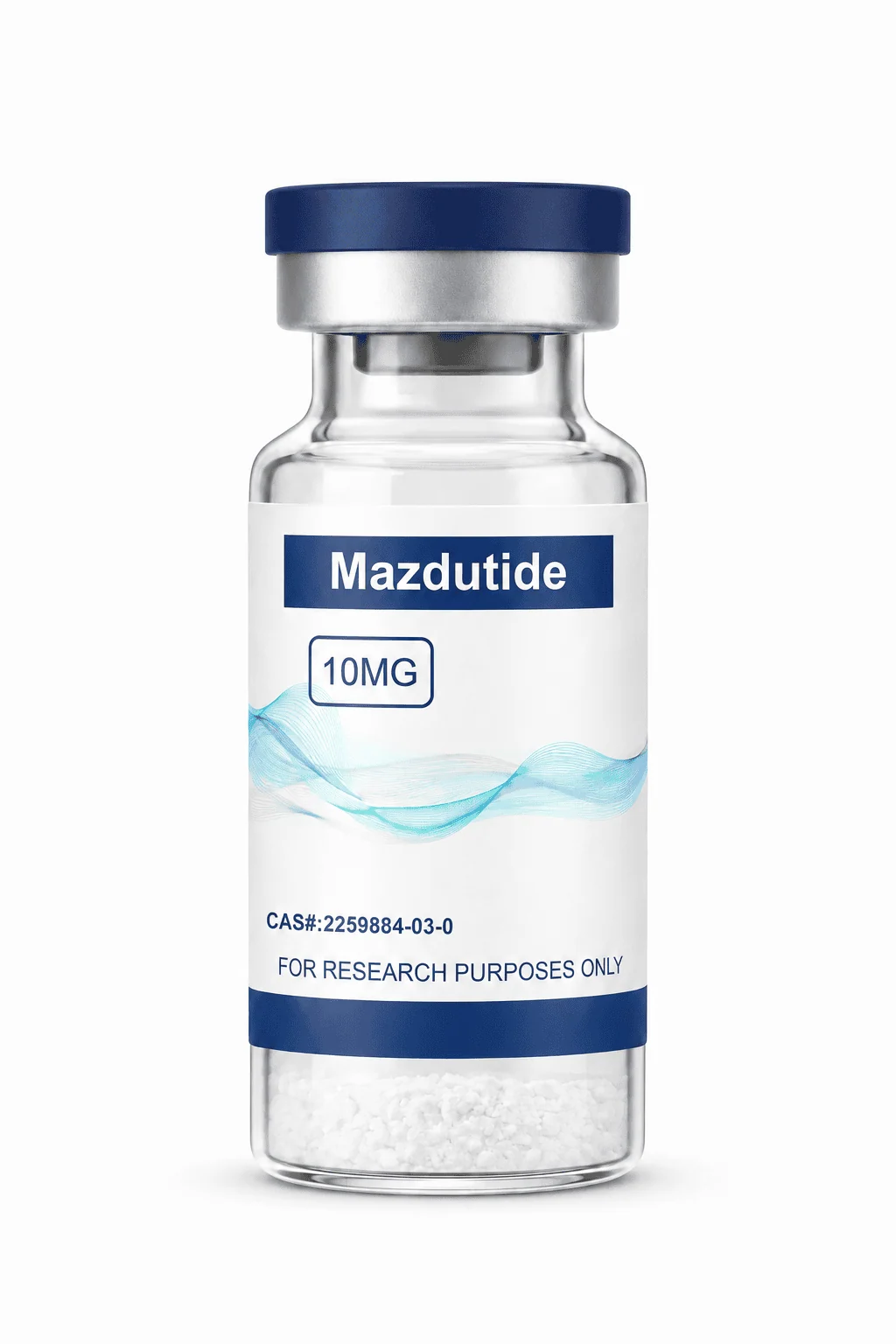
Code IBI362 / OXM-003
Also Known As Oxyntomodulin Analogue
Class Long-Acting Dual GLP-1R / GCGR Agonist
Form Lyophilized Powder
Dual Receptor Targets
Peptide Length
Molecular Weight
Mazdutide (INN; code IBI362, OXM-003) is a long-acting, C18 fatty acid–conjugated analogue of oxyntomodulin (OXM), the 37-amino acid proglucagon-derived peptide co-produced with GLP-1 in intestinal L-cells that naturally co-agonises both GLP-1 receptors (GLP-1R) and glucagon receptors (GCGR). Unlike the selective GLP-1R agonists semaglutide or liraglutide—which engage the incretin axis exclusively—mazdutide recruits a complementary GCGR-mediated pharmacological dimension encompassing hepatic glucose and lipid metabolism modulation, enhanced fatty acid oxidation, and energy expenditure upregulation via thermogenic pathways. This dual receptor engagement mirrors the broader metabolic profile of native OXM while overcoming its primary limitations: native OXM’s plasma half-life is only minutes due to N-terminal DPP-IV cleavage and rapid renal clearance, and its intrinsic receptor potency is 50–100-fold lower than the native ligands. Mazdutide incorporates an Aib² substitution (α-aminoisobutyric acid at position 2) to block DPP-IV cleavage at the His¹–Xaa² bond, selected backbone substitutions to optimise potency and selectivity at both receptor subtypes, and a C18 fatty diacid conjugated via a γ-Glu/mini-PEG linker for albumin-mediated half-life extension to approximately seven days — enabling once-weekly research dosing paradigms that are impractical with native OXM or earlier short-acting analogues.
Molecular Profile
structural class · receptor targets · key modifications · backbone
structural class · receptor targets · key modifications · backbone
| Property | Detail |
|---|---|
| INN / Code Name | Mazdutide; IBI362; OXM-003 |
| CAS Number | 2259884-03-0 |
| Structural Class | 37-AA Oxyntomodulin (OXM) Analogue — Fatty Acid Conjugated |
| Molecular Weight | ~5,100 Da (approximate; refer to Certificate of Analysis) |
| Backbone Length | 37 Amino Acids (OXM scaffold) |
| Native Scaffold | Oxyntomodulin: HAEGTFTSDVSSYLEGQAAKEFIAWLVKGRNAVGDKS — 37 AA, ~4,056 Da, t½ <5 min |
| Primary Receptors | GLP-1R (Class B GPCR, Gαs) + GCGR (Class B GPCR, Gαs) |
| Receptor Selectivity | Dual agonist; GLP-1R potency comparable to or exceeding native GLP-1; GCGR potency optimised vs native OXM (see CoA for EC₅₀ values) |
| DPP-IV Resistance | Aib² substitution — α-aminoisobutyric acid at position 2 blocks dipeptidyl peptidase-IV cleavage at His¹–Xaa² bond |
| PK Extension | C18 fatty diacid (octadecanedioic acid derivative) via γ-Glu–2×mini-PEG linker at Lys side chain → reversible albumin Cys-34 binding; t½ ~7 days |
| Terminus | Free N-terminus (His¹); C-terminal amide |
| No. of Cys | None — no disulfide bridge (unlike amylin analogues) |
In Vitro Research Context
dual GLP-1R/GCGR agonism · OXM scaffold · cAMP signalling
dual GLP-1R/GCGR agonism · OXM scaffold · cAMP signalling
The defining biochemical feature of the OXM scaffold is concurrent activation of two Class B GPCRs that normally respond to structurally related but distinct endogenous ligands. GLP-1R and GCGR share ~40–45% transmembrane sequence identity, and the GLP-1 and glucagon peptide sequences differ at only ~12 of their overlapping 29 N-terminal residues — a structural proximity that allows a single optimised peptide to engage both binding pockets. The C-terminal octapeptide extension of OXM relative to GLP-1(7-37) — RNAVGDKS — is believed to stabilise the peptide within the GCGR extracellular domain, conferring dual agonist character absent from GLP-1 alone. In mazdutide, an Aib² substitution (the same DPP-IV blocking strategy used at position 8 of semaglutide) prevents rapid N-terminal cleavage; selected backbone substitutions enhance intrinsic potency at both GLP-1R and GCGR relative to native OXM; and a C18 fatty diacid conjugated via a γ-Glu–2×OEG linker at a specific Lys side chain enables non-covalent binding to albumin Cys-34, converting the minutes-long half-life of native OXM into a ~7-day pharmacokinetic profile suited to chronic dosing paradigms — while maintaining the complementary hepatic GCGR axis that purely GLP-1R-selective agents such as semaglutide do not recruit.
GLP-1R / GCGR agonist landscape — structural and pharmacological context:
| Peptide | GLP-1R | GCGR | Backbone | Half-Life Profile |
|---|---|---|---|---|
| Native GLP-1(7-36)NH₂ | Full agonist | Inactive | 30 AA | ~2 min |
| Native Glucagon | Low partial | Full agonist | 29 AA | ~3–6 min |
| Native OXM | Partial (~50× lower than GLP-1) | Partial (~50× lower than glucagon) | 37 AA | ~7–12 min |
| Semaglutide | Full agonist (optimised) | Inactive | 31 AA (modified) | ~7 days |
| Mazdutide ★ | Full agonist (optimised) | Full agonist (optimised) | 37 AA (modified) | ~7 days |
Competitive radioligand binding assays at GLP-1R and GCGR; cAMP accumulation EC₅₀ profiling; receptor selectivity ratio determination; β-arrestin recruitment and receptor internalisation studies.
GCGR-mediated hepatic glucose production models; glycogenolysis and gluconeogenesis pathway assays; fatty acid oxidation and lipid flux studies; VLDL secretion and triglyceride clearance models.
GLP-1R-mediated hypothalamic appetite circuit studies (NPY/AgRP/POMC axis); GCGR-driven thermogenesis models; brown and beige adipose tissue activation assays; energy substrate utilisation flux.
Gαs → adenylyl cyclase → cAMP → PKA pathway activation at both GLP-1R and GCGR; downstream CREB phosphorylation assays; insulin secretion models in beta-cell lines; glucagon secretion suppression assays in alpha-cell models.
Available Formats
vial sizes · physical form · purity specification
vial sizes · physical form · purity specification
| Format | Amount | Physical Form | Purity | Storage |
|---|---|---|---|---|
| Mazdutide | 10 mg | Lyophilised powder | ≥98% | −20 °C |
Purity verification: Each batch is characterised by HPLC and mass spectrometry. Certificate of Analysis available upon request. Confirm molecular weight and purity against CoA prior to research use — particularly important for fatty acid–conjugated peptides where linker variants may affect exact MW.
Laboratory Storage
lyophilised · reconstituted · stability considerations
lyophilised · reconstituted · stability considerations
| Condition | Guidance |
|---|---|
| Long-Term (Lyophilised) | −20 °C or below, desiccated, protected from light; stable for ≥24 months under recommended conditions |
| Short-Term (Lyophilised) | 4 °C for up to 4 weeks; minimise temperature cycling to prevent moisture uptake |
| Reconstituted Solutions | Store at −20 °C in single-use aliquots; avoid repeated freeze-thaw cycles which promote C18-mediated aggregation |
| No Disulfide Bridge | OXM backbone contains no Cys residues — no disulfide oxidation or shuffling risk; simplifies redox-sensitive assay design |
| Trp Photooxidation | Trp²⁵ in the OXM backbone is susceptible to photooxidation in aqueous solution — protect from UV and high-intensity visible light during reconstitution and assay handling |
| C18 Fatty Acid | Diacid linker is hydrolytically stable at neutral pH; avoid strongly acidic or basic conditions (pH <4 or >9) that may cleave the ester bond; C18 chain promotes aggregation at concentrations >2 mg/mL in low ionic-strength buffers |
| DPP-IV Stability | Aib² substitution renders mazdutide resistant to DPP-IV cleavage; standard culture media DPP-IV activity does not degrade the peptide under normal assay timescales |
Reconstitution vehicle: PBS (pH 7.4) containing 0.01–0.05% polysorbate 20 is recommended for working solutions to minimise surface adsorption and C18-mediated aggregation. The albumin-binding character of the C18 chain means peptide recovery from plasticware may be reduced at low concentrations — use siliconised tubes where precise low-nanomolar dosing is required.
Research Literature
selected references · OXM pharmacology · dual GLP-1R/GCGR agonism
selected references · OXM pharmacology · dual GLP-1R/GCGR agonism
Ji et al. (2023) — Efficacy and safety of mazdutide (IBI362) in Chinese adults with overweight or obesity: a phase 2, randomised, double-blind, placebo-controlled study. The Lancet Diabetes & Endocrinology. PMID: 36931253. Phase 2 clinical characterisation of mazdutide pharmacodynamics and receptor engagement.
Pocai et al. (2009) — Glucagon-like peptide 1/glucagon receptor dual agonism reverses obesity in mice. Diabetes. PMID: 19543232. Foundational preclinical proof-of-concept for the dual GLP-1R/GCGR agonism strategy underpinning the OXM scaffold.
Baggio & Drucker (2007) — Biology of incretins: GLP-1 and GIP. Gastroenterology. PMID: 17606895. Comprehensive review of GLP-1R pharmacology, incretin axis biology, and the structural basis for Class B GPCR–selective ligand design relevant to mazdutide’s GLP-1R agonism component.
Mazdutide supplied by NexPept is intended exclusively for in vitro laboratory research and preclinical investigation. This material is not approved for human or veterinary administration in Canada or any other jurisdiction and does not constitute a drug product, natural health product, or therapeutic agent.
Researchers are responsible for ensuring all use complies with applicable institutional biosafety protocols, ethics board requirements, and federal regulations. For full product specifications, analytical data, and batch documentation, refer to the Certificate of Analysis provided with each order.
Product page: nexpept.ca — Mazdutide Research Peptide Overview
Be the first to review “MAZDUTIDE 10MG”
Related products
Reviews
There are no reviews yet.