
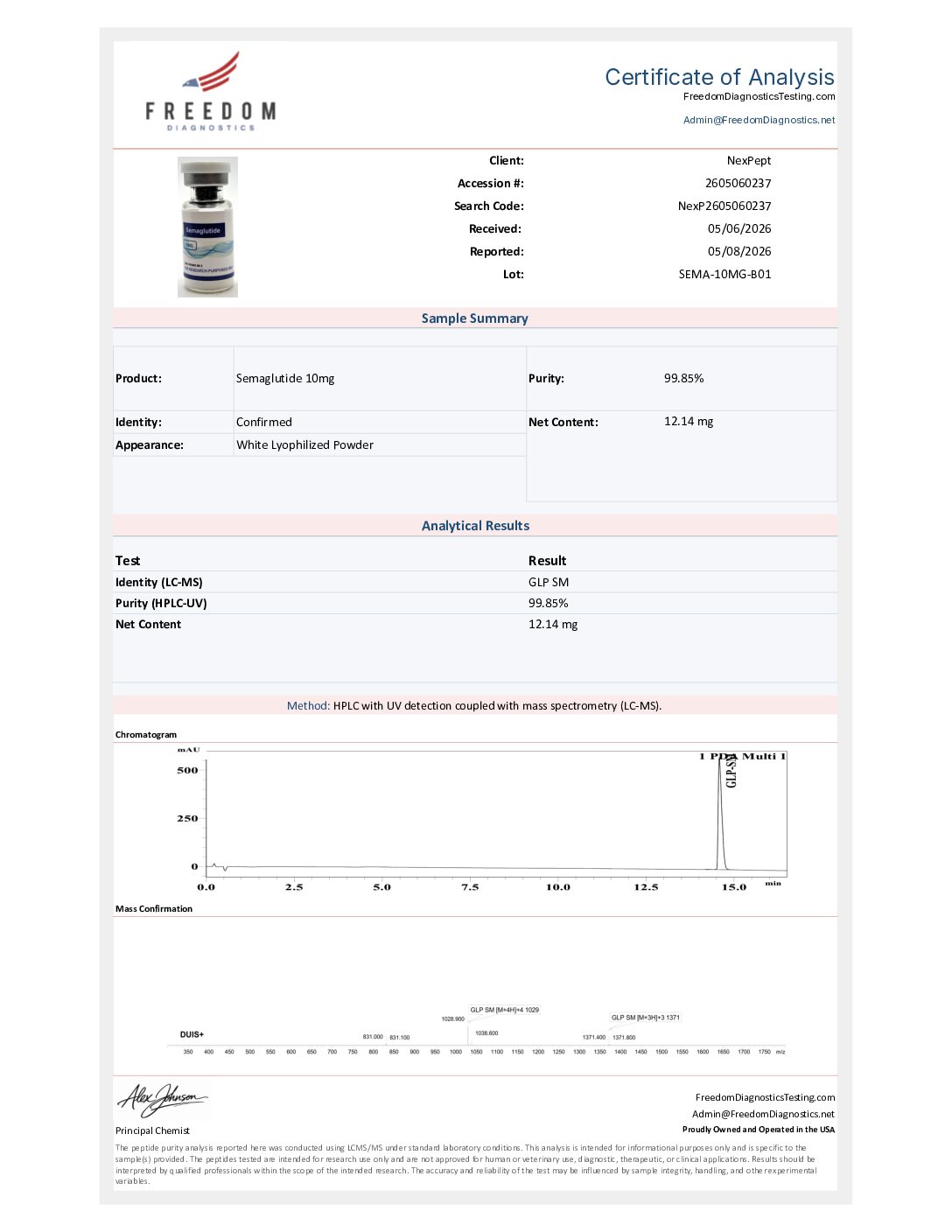
HPLC + MS
Independently tested for identity and purity
SEMA-10MG-B01
May 28, 2026
99.85%
View Certificate of Analysis
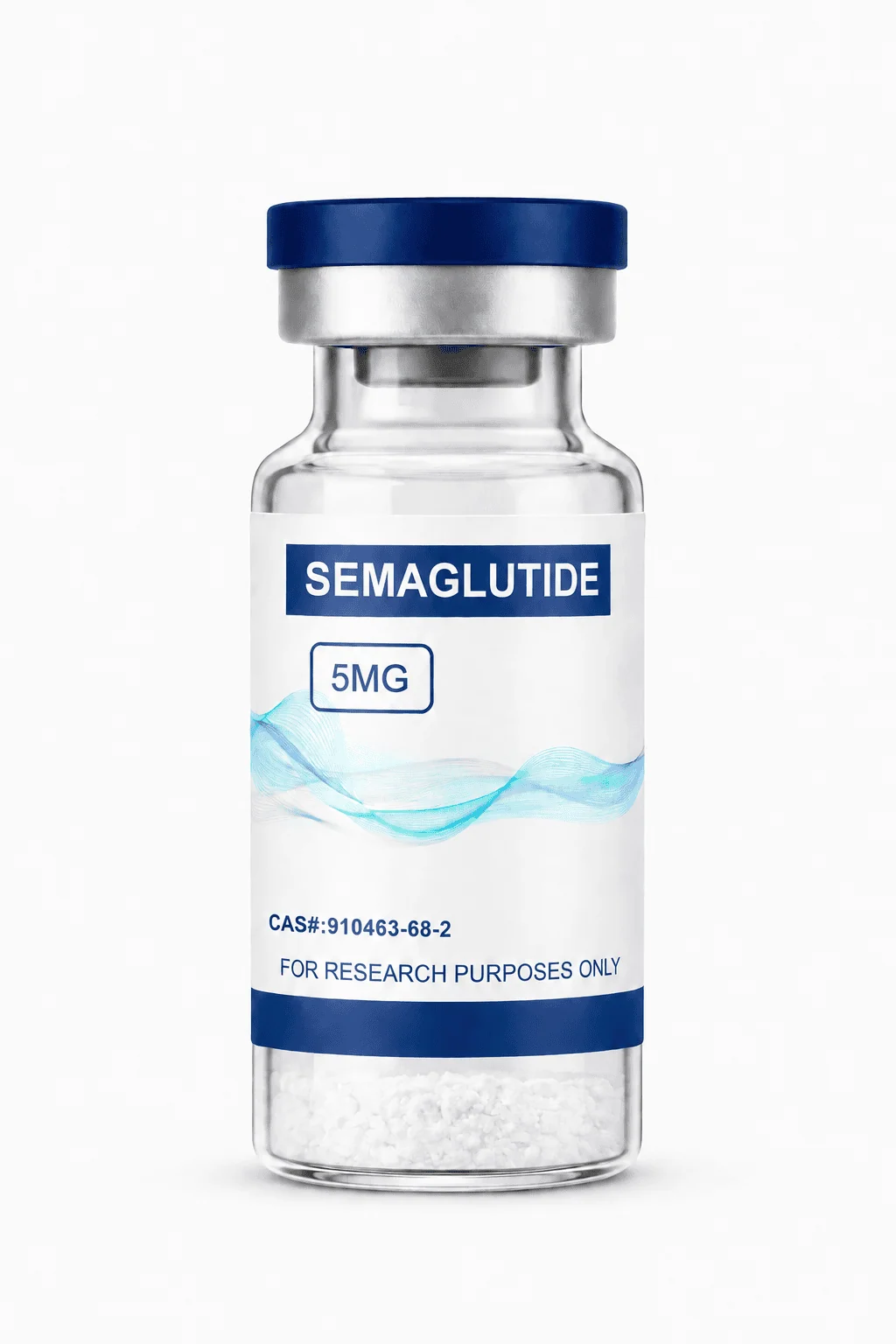
CAS# 910463-68-2
Also Known As GLP-1 Analogue / C18 Fatty Diacid Conjugate
Class Synthetic GLP-1 Receptor Agonist — Long-Acting
Form Lyophilized Powder
Receptor Target
Peptide Length
Molecular Weight
Semaglutide (CAS# 910463-68-2) is a synthetic 31-amino-acid glucagon-like peptide-1 (GLP-1) receptor agonist derived from native GLP-1(7-37) with three key structural modifications: an Aib (α-aminoisobutyric acid) substitution at position 8 for DPP-IV resistance, a Lys34→Arg substitution, and a C18 fatty diacid moiety conjugated via a mini-PEG / γ-Glu linker enabling non-covalent albumin binding. It is studied in vitro and in preclinical models as a high-affinity GLP-1R agonist for receptor pharmacology, cAMP signalling cascade research, pancreatic beta cell signalling models, and metabolic pathway studies. Supplied by NexPept as a lyophilized powder for in vitro laboratory research use. This compound has not been authorized by Health Canada for any therapeutic, clinical, or human use.
Molecular Profile
CAS#, sequence, structural modifications, molecular weight, analytical data
CAS#, sequence, structural modifications, molecular weight, analytical data
| Property | Value |
|---|---|
| CAS Number | 910463-68-2 |
| Research Designation | Semaglutide; GLP-1 analogue; GLP-1RA |
| Compound Class | Synthetic GLP-1 receptor agonist — long-acting albumin-binding conjugate |
| Parent Sequence | GLP-1(7-37) — 31-amino-acid incretin peptide derived from proglucagon |
| Sequence Length | 31 amino acids |
| Molecular Formula | C₁₈₇H₂₉₁N₄₅O₅₉ |
| Molecular Weight | ~4113.6 Da |
| Modification 1 | Aib⁸ — α-aminoisobutyric acid at position 8; protects against DPP-IV cleavage at the His-Aib bond |
| Modification 2 | Lys³⁴→Arg substitution — repositions the fatty acid conjugation site to Lys²⁶ |
| Modification 3 | C18 fatty diacid (octadecanedioic acid) via mini-PEG (2×OEG) / γ-Glu linker at Lys²⁶ — enables reversible albumin binding |
| Receptor Target | GLP-1R (GLP-1 receptor) — Class B GPCR; Gαs-coupled |
| Physical Form | Lyophilized powder |
| Analytical Method | High-Performance Liquid Chromatography (HPLC) + Mass Spectrometry (MS) |
| Appearance | White to off-white lyophilized solid |
In Vitro Research Context
GLP-1R pharmacology, cAMP signalling & metabolic pathway models — laboratory use only
GLP-1R pharmacology, cAMP signalling & metabolic pathway models — laboratory use only
Semaglutide’s extended research utility relative to native GLP-1 derives from a C18 fatty diacid (octadecanedioic acid) conjugated at Lys²⁶ via a bifunctional linker comprising two mini-PEG (OEG) units and a γ-glutamic acid spacer. This hydrophobic tail binds non-covalently and reversibly to Cys-34 of serum albumin, dramatically reducing renal clearance and extending the plasma half-life in preclinical models — a mechanism conceptually analogous to the maleimide-based albumin conjugation in CJC-1295 With DAC, but achieved through non-covalent hydrophobic interaction rather than a covalent thiol bond. The Aib⁸ substitution at the DPP-IV cleavage site (His-Ala → His-Aib) eliminates the primary enzymatic degradation pathway, with the fatty acid modification providing a secondary protease-resistance effect through albumin association. Together, these modifications make semaglutide the structurally most elaborated GLP-1 analogue widely used as an in vitro tool compound.
Semaglutide is used in GLP-1R binding displacement assays, receptor activation kinetics (TR-FRET, HTRF), and agonist potency profiling experiments in GLP-1R-expressing cell lines and membrane preparations. Its high receptor affinity and resistance to enzymatic degradation make it a preferred tool compound for longer-duration GLP-1R pharmacology assays.
GLP-1R is a Class B GPCR that couples via Gαs to adenylyl cyclase. Semaglutide is studied in cAMP accumulation assays, PKA substrate phosphorylation studies, CREB activation experiments, and β-arrestin recruitment assays in GLP-1R-transfected HEK293 and CHO cell lines.
GLP-1R is highly expressed on pancreatic beta cells. Semaglutide is studied in INS-1, MIN6, and primary islet cell preparations to examine GLP-1R-driven cAMP amplification of glucose-stimulated insulin secretion signalling pathways, beta cell survival signalling (PI3K/Akt), and incretin pathway dynamics.
GLP-1R expression in hypothalamic nuclei makes semaglutide a tool compound for neuroendocrine signalling research. It is studied in hypothalamic cell preparations examining GLP-1R-mediated neuropeptide interactions, energy sensing pathway models, and downstream AMPK and mTOR signalling studies.
GLP-1 Receptor Agonist Analogue Comparison
| Analogue | Length | Key Structural Feature | Half-Life Profile (Preclinical) |
|---|---|---|---|
| Native GLP-1(7-36)amide | 30 AA | Endogenous incretin; rapid DPP-IV cleavage at His-Ala bond | Minutes — rapid enzymatic degradation |
| Exendin-4 | 39 AA | Exendin scaffold; Gly² instead of Ala² — inherent DPP-IV resistance | Hours — renal clearance limited |
| Liraglutide | 31 AA | Arg³⁴→Lys; C16 fatty acid (palmitic acid) via γ-Glu — albumin binding | ~13 hours — albumin-mediated |
| Semaglutide ★ | 31 AA | Aib⁸ DPP-IV protection + C18 fatty diacid via 2×OEG/γ-Glu linker — enhanced albumin affinity | ~7 days — optimised albumin conjugation |
Semaglutide’s combination of Aib⁸-mediated DPP-IV resistance and C18 fatty diacid albumin binding represents the most structurally optimised approach to long-acting GLP-1R agonism in the research literature. In cell-based assays its extended stability allows study of sustained GLP-1R activation and receptor desensitisation / internalisation kinetics — research endpoints that are impractical with rapidly degraded native GLP-1 or shorter-acting analogues. The mini-PEG linker also adds aqueous solubility relative to direct fatty acid conjugation, improving assay performance in standard tissue culture media.
Research context: Semaglutide is an investigational synthetic GLP-1 receptor agonist studied in scientific research involving receptor pharmacology, cAMP signalling cascades, incretin pathway biology, and metabolic signalling models. It has not been authorized by Health Canada for human or veterinary use.
Available Formats
5 mg and 10 mg — lyophilized powder
5 mg and 10 mg — lyophilized powder
| Format | Net Quantity | Physical Form |
|---|---|---|
| Semaglutide 5mg | 5 mg / vial | Lyophilized powder |
| Semaglutide 10mg | 10 mg / vial | Lyophilized powder |
Sourced from a verified batch. Quantity for use should be determined based on your specific in vitro research protocol by qualified research personnel.
Laboratory Storage
Controlled storage conditions for lyophilized material
Controlled storage conditions for lyophilized material
Store sealed lyophilized material under controlled laboratory conditions in accordance with validated institutional SOPs and applicable technical documentation. Protect from light and moisture. Semaglutide contains a Trp residue within the GLP-1 core sequence that is susceptible to photooxidation — protection from UV and prolonged ambient light exposure is recommended. The C18 fatty diacid side chain is stable under lyophilized conditions but may exhibit concentration-dependent aggregation behaviour in solution at low ionic strength — use physiologically buffered aqueous vehicles and consult the batch CoA for recommended reconstitution guidance. As a 31-AA fatty acid-conjugated peptide, semaglutide has higher aqueous solubility than many lipopeptides due to the hydrophilic mini-PEG linker; nevertheless, avoid non-polar organic solvents. Reconstituted aliquots should be stored at 4 °C for short-term use and −20 °C for longer storage; avoid repeated freeze-thaw cycles.
Note: No preparation, reconstitution, or administration instructions are provided. This compound is supplied for in vitro laboratory research use only. All handling must be conducted by qualified personnel following institutional safety protocols.
Research Literature
Scientific references & related resources
Scientific references & related resources
Semaglutide Research Peptide Overview — NexPept compound overview and in vitro research context
PubMed — Semaglutide GLP-1R Pharmacology — peer-reviewed literature on receptor binding, cAMP signalling, and incretin pathway research
PubMed — GLP-1R Agonist Signalling Models — cAMP cascade, beta cell signalling, and Class B GPCR research
Research Peptides in Canada — sourcing and research context for Canadian laboratories
What Are Research Peptides? — peptide classification and in vitro research context
This product is supplied exclusively for in vitro laboratory and non-clinical research use by qualified research personnel. It is not authorized by Health Canada for human or veterinary use. No therapeutic, clinical, or health claims are made.
This material must not be administered to humans or animals. No dosage, preparation, reconstitution, or administration instructions are provided or implied. All handling and use must be conducted by qualified personnel in accordance with applicable institutional policies and legal requirements.
Be the first to review “SEMAGLUTIDE 5MG”
Related products
Nootropic & Wellness Research
Reviews
There are no reviews yet.