
|
Human Cathelicidin Antimicrobial Peptide
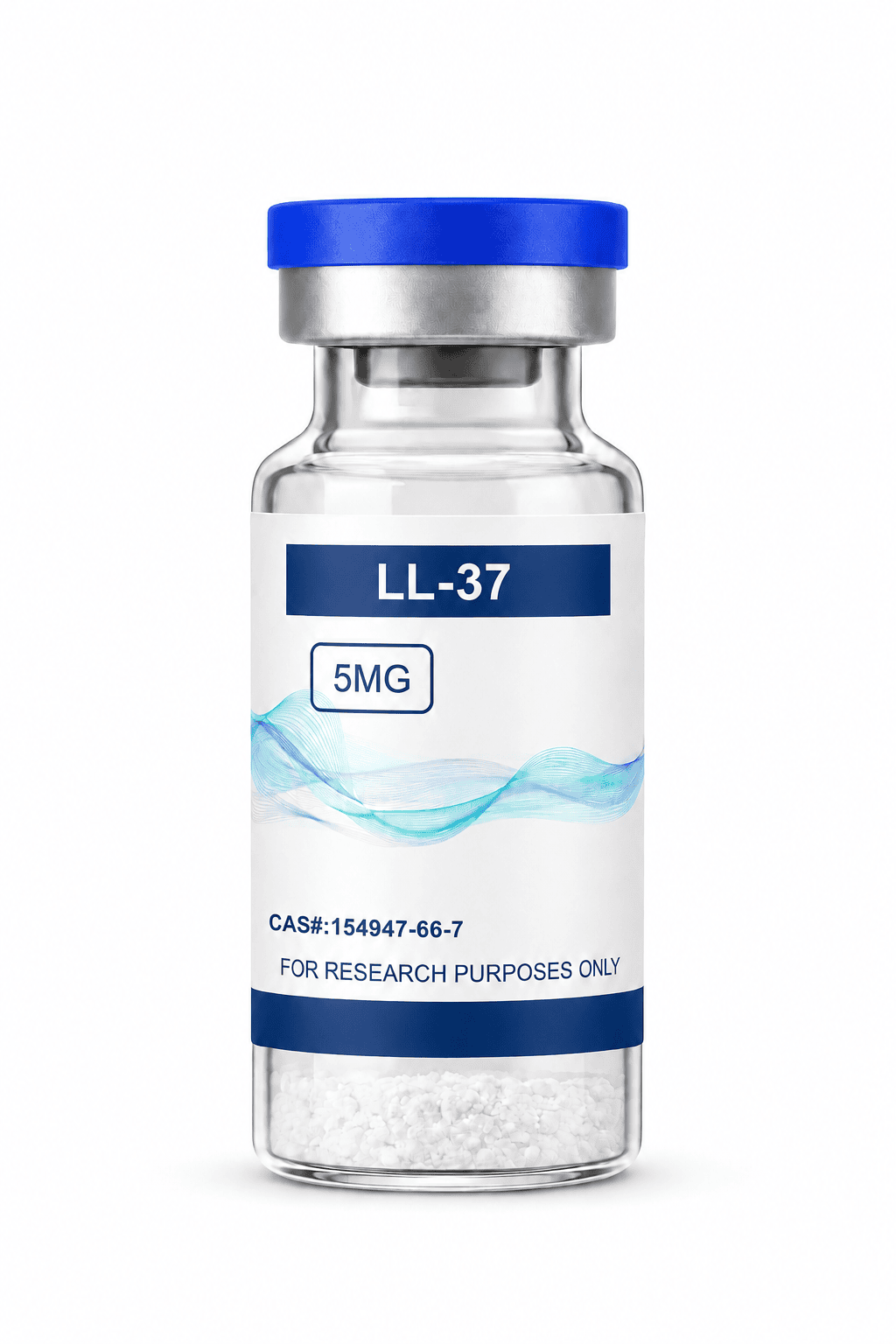
LL-37 is the sole human cathelicidin, representing the C-terminal 37-residue fragment cleaved from the precursor protein hCAP-18 (human cationic antimicrobial protein 18). The “LL” designation reflects the two N-terminal leucine residues of the mature peptide. LL-37 adopts an amphipathic α-helical conformation in membrane-mimicking environments, carrying a net charge of approximately +6 at physiological pH. It is a widely studied multifunctional research peptide with proposed roles in innate immune defence, immunomodulation, and tissue repair signalling, acting primarily through the formyl peptide receptor 2 (FPR2/FPRL1).
Molecular Profile
| Property | Detail |
|---|---|
| Sequence | Leu-Leu-Gly-Asp-Phe-Phe-Arg-Lys-Ser-Lys-Glu-Lys-Ile-Gly-Lys-Glu-Phe-Lys-Arg-Ile-Val-Gln-Arg-Ile-Lys-Asp-Phe-Leu-Arg-Asn-Leu-Val-Pro-Arg-Thr-Glu-Ser |
| Single-Letter Code | LLGDFFRKSKEKIGKEFKRIVQRIKDFLRNLVPRTES |
| Residue Count | 37 AA; linear; free N- and C-termini |
| Molecular Formula | C₂₀₅H₃₄₀N₆₀O₅₃ |
| Molecular Weight | ~4493 Da |
| CAS Number | 154947-66-7 |
| Also Known As | hCAP-18 C-terminal peptide; CRAMP (murine homologue) |
| Net Charge (pH 7) | ~+6 (cationic; 9 basic residues, 3 acidic) |
| Secondary Structure | Amphipathic α-helix (residues 2–31 in membrane-mimicking conditions) |
| Precursor Protein | hCAP-18 (CAMP gene product); cleaved by kallikrein serine proteases |
| Format | Lyophilized Powder — 5 mg/vial |
| Purity | ≥98% (HPLC) |
Research Targets & Proposed Mechanisms
Research Context
- →First characterised from human bone marrow by Agerberth et al. (1995); identified as the only member of the cathelicidin family expressed in humans, distinguishing it from the multiple cathelicidins found in other mammals
- →Expressed by neutrophils, epithelial cells, macrophages, and NK cells; released upon infection or injury — studied as an endogenous component of first-line innate immune defence research models
- →Investigated in wound healing and tissue repair models; proposed to stimulate keratinocyte migration and proliferation via EGFR transactivation, studied in scratch-assay and epithelial barrier research systems
- →Widely used in anti-biofilm research; studied for activity against Gram-positive, Gram-negative, and fungal organisms in membrane permeabilisation and biofilm disruption assays
- →Investigated in immunomodulatory research for proposed roles in angiogenesis, apoptosis regulation, and neutrophil extracellular trap (NET) formation models
Storage & Handling
Store sealed lyophilized material under controlled laboratory conditions in accordance with validated institutional SOPs and applicable technical documentation. Protect from light and moisture.
- →Keep in original sealed vial until use in research protocols
- →LL-37’s cationic character means it may adsorb to standard polypropylene surfaces in dilute solution; use low-binding tubes and add carrier protein where appropriate per institutional SOP
- →Handle in accordance with institutional biosafety and chemical handling guidelines
Literature & Resources
- →NexPept — LL-37 Research Peptide Overview: nexpept.ca
- →Agerberth B et al. “FALL-39, a putative human peptide antibiotic, is cysteine-free and expressed in bone marrow and testis.” Proc Natl Acad Sci USA, 1995 — PMID 7568028
- →Mookherjee N, Hancock REW. “Cationic host defence (antimicrobial) peptides: immunomodulatory asset?” Cell Mol Life Sci, 2007 — PMID 17558473
- →PubChem Compound — LL-37 (CID 16198951): pubchem.ncbi.nlm.nih.gov
Be the first to review “LL-37 5MG”
Related products
Peptides
Reviews
There are no reviews yet.