
HPLC + MS
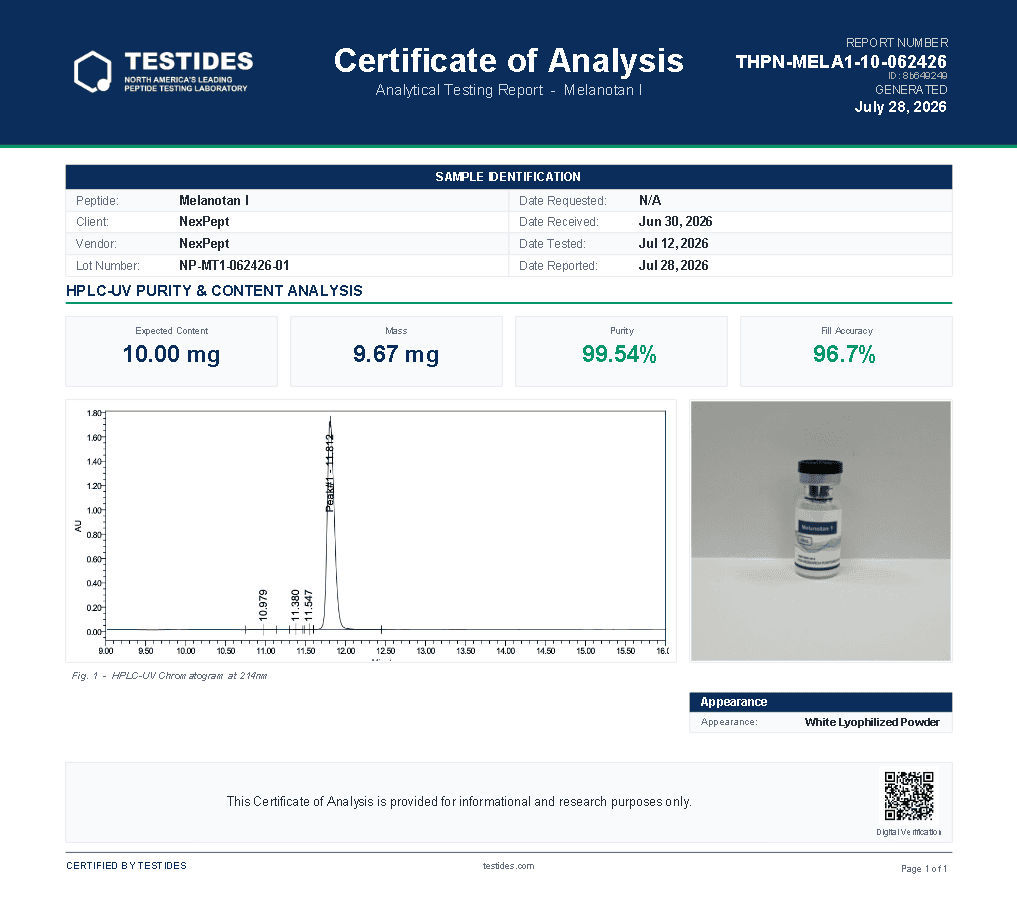
Independently tested for identity and purity
NP-MT1-062426-01
Jul 28, 2026
99.54%
View Certificate of Analysis
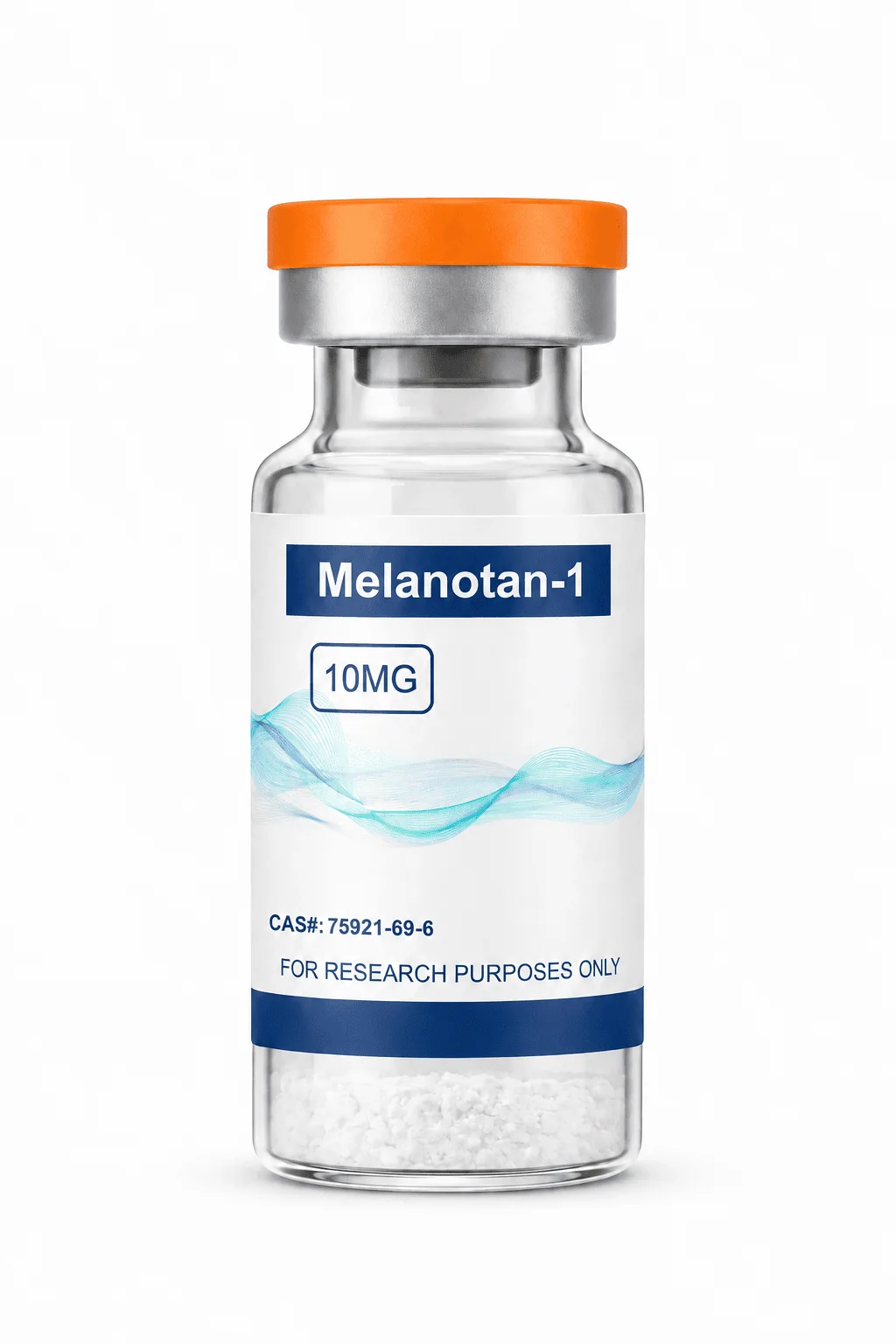
CAS# 75921-69-6
INN Afamelanotide
Class Synthetic Linear α-MSH Analogue / MC1R Agonist
Form Lyophilized Powder
Primary Receptor Target
Peptide Length
Molecular Weight
Melanotan-1 (INN: afamelanotide; CAS 75921-69-6) is a synthetic linear 13-amino acid analogue of native α-melanocyte-stimulating hormone (α-MSH) bearing two targeted substitutions — Nle⁴ and D-Phe⁷ — that substantially improve metabolic stability and melanocortin receptor 1 (MC1R) binding potency relative to the parent sequence. Native α-MSH has a plasma half-life of only minutes due to N-terminal deamidation and rapid proteolysis; the [Nle⁴, D-Phe⁷] modifications in MT-1 eliminate the primary oxidation liability and introduce a conformational constraint at the critical His-Phe-Arg pharmacophore that confers approximately 1,000-fold greater MC1R binding affinity versus unmodified α-MSH. Melanotan-1 retains the full 13 AA linear scaffold of the native hormone — in direct contrast to the cyclic 7 AA lactam architecture of Melanotan-2 (MT-2) — resulting in a more selective MC1R engagement profile and a distinct receptor subtype distribution across the five melanocortin receptor subtypes (MC1R–MC5R). In preclinical cell-based and rodent models, MT-1 has been applied to melanogenesis pathway studies, MC1R-mediated photoprotection and DNA repair assays, anti-inflammatory signalling research, and comparative melanocortin receptor pharmacology. Supplied by NexPept as lyophilized powder for in vitro laboratory research use.
Molecular Profile
CAS · sequence · formula · receptor subtype · key modifications
CAS · sequence · formula · receptor subtype · key modifications
| Property | Detail |
|---|---|
| CAS Number | 75921-69-6 |
| INN | Afamelanotide (Melanotan-1; MT-1) |
| Sequence | Ac-Ser-Tyr-Ser-Nle-Glu-His-D-Phe-Arg-Trp-Gly-Lys-Pro-Val-NH₂ |
| Molecular Formula | C₇₈H₁₁₁N₂₁O₁₉ |
| Molecular Weight | ~1,646.9 Da |
| Peptide Length | 13 Amino Acids (linear; same backbone length as native α-MSH) |
| Structure | Linear — no cyclic lactam bridge (contrast with MT-2’s Asp–Lys lactam) |
| Terminus | N-terminal acetylation (Ac-); C-terminal amide (-NH₂) — same as native α-MSH |
| Primary Receptor | MC1R (melanocortin receptor 1; Class A GPCR, Gαs-coupled) |
| Secondary Receptors | MC3R, MC4R, MC5R — activated at higher concentrations; ~10–100× lower potency vs MC1R |
| Nle⁴ Substitution | Norleucine replaces Met⁴ — eliminates Met sulfoxide oxidation liability; preserves hydrophobic side chain required for receptor binding |
| D-Phe⁷ Substitution | D-stereoisomer at position 7 — ~1,000× potency increase at MC1R vs native α-MSH; conformational stabilisation of the His⁶–Phe⁷–Arg⁸ pharmacophore; resistance to proteolytic cleavage at this bond |
| Native Comparator | α-MSH: Ac-Ser-Tyr-Ser-Met-Glu-His-Phe-Arg-Trp-Gly-Lys-Pro-Val-NH₂ · ~1,665 Da · t½ <5 min |
| Analytical Method | High-Performance Liquid Chromatography (HPLC) + Mass Spectrometry (MS) |
| Appearance | White to off-white lyophilized powder |
In Vitro Research Context
Nle⁴/D-Phe⁷ modifications · MC1R selectivity · melanogenesis · MT-1 vs MT-2
Nle⁴/D-Phe⁷ modifications · MC1R selectivity · melanogenesis · MT-1 vs MT-2
The two modifications that define MT-1 relative to native α-MSH each address a distinct limitation. Nle⁴ (norleucine) replaces Met⁴, removing the thioether sulfur that renders native α-MSH prone to oxidative sulfoxide formation during peptide synthesis, storage, and in biological matrices — the Nle isoelectronic side chain preserves the hydrophobic packing geometry needed for receptor contact without the oxidation liability. D-Phe⁷ introduces a stereochemical inversion at the critical His⁶–Phe⁷–Arg⁸ tripeptide that forms the primary MC1R binding pharmacophore: the D-configuration locks this triad into a bioactive turn conformation, increasing MC1R binding affinity approximately 1,000-fold relative to the native L-Phe sequence and simultaneously rendering the His–D-Phe peptide bond resistant to serine protease cleavage. The retained linear 13 AA scaffold of MT-1 distinguishes it pharmacologically from MT-2 — the cyclic [Nle⁴, cyclo(Asp&sup5;, D-Phe⁷, Lys¹⁰)]-α-MSH(4-10) heptapeptide. MT-2’s lactam rigidity compresses the pharmacophore into a constrained conformation that enhances potency at MC4R and MC5R in addition to MC1R; MT-1’s linear scaffold retains a larger extracellular contact surface favouring MC1R selectivity over non-melanocyte receptor subtypes. Researchers apply MT-1 where MC1R-dominant pathway activation is desired — melanogenesis, photoprotection, and anti-inflammatory models — while MT-2 is preferred for broader melanocortin receptor selectivity profiling across MC1R–MC5R. For a direct side-by-side breakdown of the two scaffolds and their receptor profiles, see Melanotan 1 vs Melanotan 2.
Melanocortin analogue landscape — structural and receptor selectivity context:
| Peptide | Length / Structure | MC1R | MC4R | Key Research Application |
|---|---|---|---|---|
| Native α-MSH | 13 AA / Linear | Moderate (reference) | Moderate | Reference ligand; rapid degradation in assay |
| Melanotan-1 (MT-1) ★ | 13 AA / Linear | High (~1,000× vs α-MSH) | Lower (MC1R-biased) | MC1R/melanogenesis/photoprotection research |
| Melanotan-2 (MT-2) | 7 AA / Cyclic lactam | High | High (broader selectivity) | Broad MC1R–MC5R pharmacology studies |
MC1R binding affinity and cAMP accumulation assays; receptor subtype selectivity profiling (MC1R vs MC3R/MC4R/MC5R); competitive displacement vs native α-MSH and MT-2; Gαs activation and β-arrestin recruitment characterisation.
MC1R → cAMP → PKA → MITF transcription factor activation; tyrosinase (TYR), DCT, and TYRP1 expression assays; eumelanin vs phaeomelanin switch studies in melanocyte cell models; melanin quantification assays.
MC1R-mediated nucleotide excision repair (NER) pathway studies; cyclobutane pyrimidine dimer (CPD) formation and clearance assays; reactive oxygen species (ROS) modulation in UV-exposed keratinocyte models; xeroderma pigmentosum pathway research context.
MC1R-mediated NF-κB nuclear translocation suppression assays; pro-inflammatory cytokine (IL-6, TNF-α, IL-1β) modulation in LPS-stimulated macrophage and keratinocyte models; melanocyte-immune crosstalk research in co-culture systems.
Available Formats
vial sizes · physical form · purity specification
vial sizes · physical form · purity specification
| Format | Amount | Physical Form | Purity | Storage |
|---|---|---|---|---|
| Melanotan-1 | 10 mg | Lyophilised powder | ≥98% | −20 °C |
Purity verification: Each batch is characterised by HPLC and mass spectrometry. Certificate of Analysis available upon request. Confirm sequence identity, molecular weight, and Nle/D-Phe modification integrity against CoA prior to receptor binding assay use.
Laboratory Storage
lyophilised · reconstituted · residue-specific stability
lyophilised · reconstituted · residue-specific stability
| Condition | Guidance |
|---|---|
| Long-Term (Lyophilised) | −20 °C or below, desiccated, protected from light; stable for ≥24 months under recommended conditions |
| Short-Term (Lyophilised) | 4 °C for up to 4 weeks; minimise temperature cycling |
| Reconstituted Solutions | Store at −20 °C in single-use aliquots; avoid repeated freeze-thaw cycles; use within 2–4 weeks at 4 °C |
| No Met Oxidation Risk | Nle⁴ substitution eliminates the primary Met oxidation liability of native α-MSH; MT-1 is more oxidatively stable than the native hormone in aqueous solution |
| Trp⁹ Photooxidation | Trp at position 9 is susceptible to photooxidation in aqueous solution — protect reconstituted solutions from UV and high-intensity visible light; use amber vials where possible |
| Tyr² Stability | Tyr² phenol ring is a minor photooxidation risk in dilute aqueous solution; standard light-protection precautions sufficient |
| No Disulfide / No Cyclic Bridge | MT-1 is a linear peptide with no Cys residues and no lactam bridge — no disulfide or cyclic structure to monitor; simpler stability profile than MT-2 |
| pH Stability | Stable at physiological pH (6.5–7.5); avoid strongly acidic conditions that may promote Asp/Glu-mediated hydrolysis or Trp oxidation |
Reconstitution note: Reconstitute in sterile water or PBS (pH 7.4). MT-1’s linear scaffold and absence of a hydrophobic cyclic core makes it more soluble in aqueous buffers than MT-2; no surfactant is typically required at standard research concentrations (<1 mg/mL). Avoid metal-containing buffers as His⁶ can coordinate divalent cations (Zn²⁺, Cu²⁺) that may alter receptor binding affinity in competitive assay systems.
Research Literature
selected references · MC1R pharmacology · melanogenesis · photoprotection
selected references · MC1R pharmacology · melanogenesis · photoprotection
Melanotan 1 vs Melanotan 2: Key Differences Explained — linear vs cyclic scaffold, receptor selectivity, stability and research applications compared
Sawyer TK et al. (1980) — 4-Norleucine, 7-D-phenylalanine-α-melanocyte-stimulating hormone: a highly potent α-melanotropin with ultralong biological activity. Proc Natl Acad Sci USA 77(10):5754–5758.
García-Borrón et al. (2005) — MC1R: physiological and pharmacological aspects of the receptor. Pigment Cell Research. Comprehensive review of MC1R structure, Gαs/cAMP signalling, MITF regulation, melanogenesis pathway, and the anti-inflammatory and DNA repair roles contextualising MT-1’s research applications.
Langan EA et al. (2015) — Afamelanotide for erythropoietic protoporphyria and related photodermatoses: characterisation of the MC1R-mediated photoprotective mechanism. Translational reference for MC1R-mediated photoprotection and NER pathway research using MT-1 as the experimental tool compound.
Melanotan-1 (afamelanotide) supplied by NexPept is intended exclusively for in vitro laboratory research and preclinical investigation. This material is not approved for human or veterinary administration in Canada and does not constitute a drug product, natural health product, or therapeutic agent.
Afamelanotide holds regulatory approval in certain jurisdictions for specific indications. This supply is research-grade material only and is not equivalent to, nor a substitute for, any approved drug product.
Researchers are responsible for ensuring all use complies with applicable institutional biosafety protocols, ethics board requirements, and federal regulations. For full product specifications, analytical data, and batch documentation, refer to the Certificate of Analysis provided with each order.
Be the first to review “MELANOTAN-1 10MG”
Related products
Reviews
There are no reviews yet.