
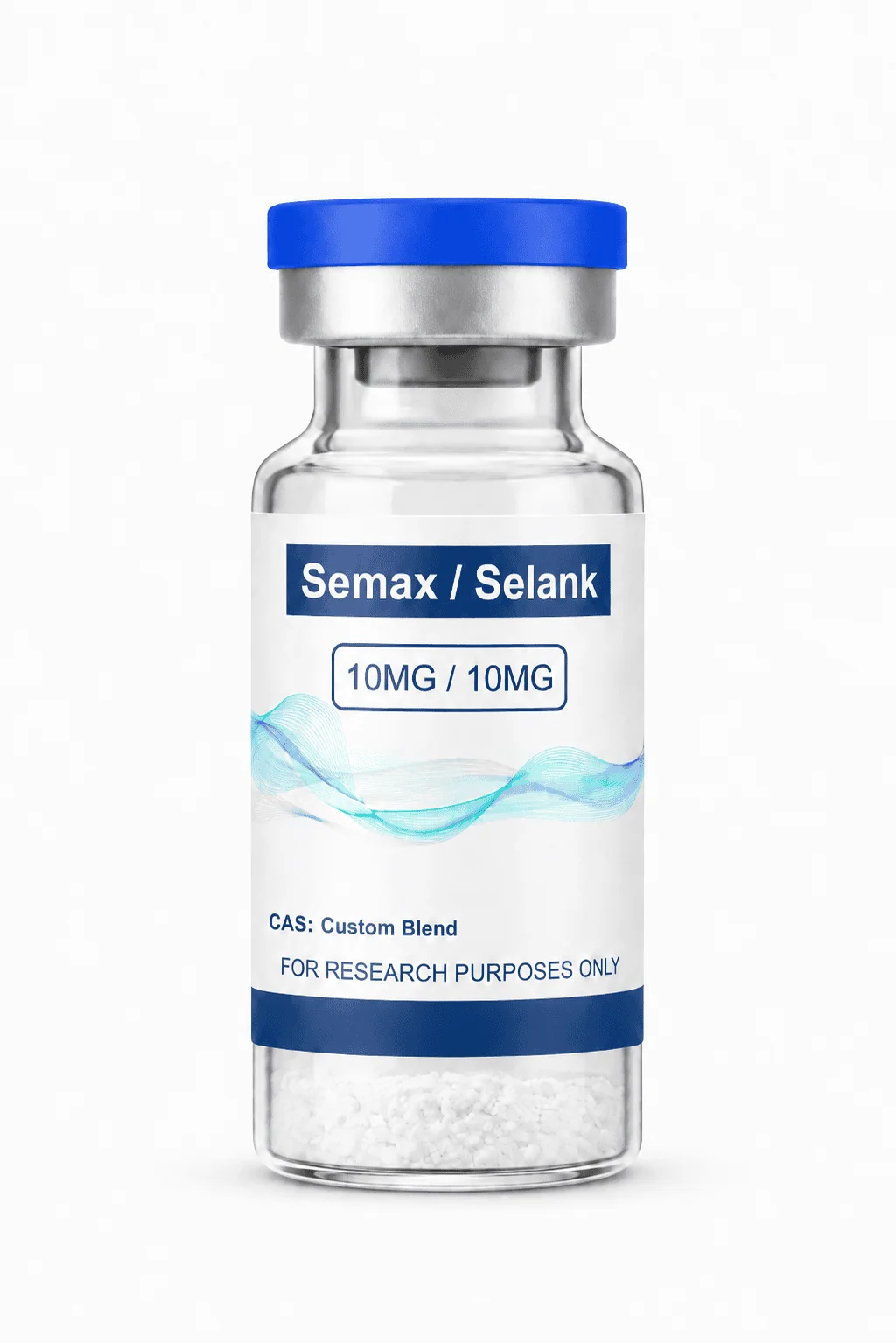
HPLC + MS
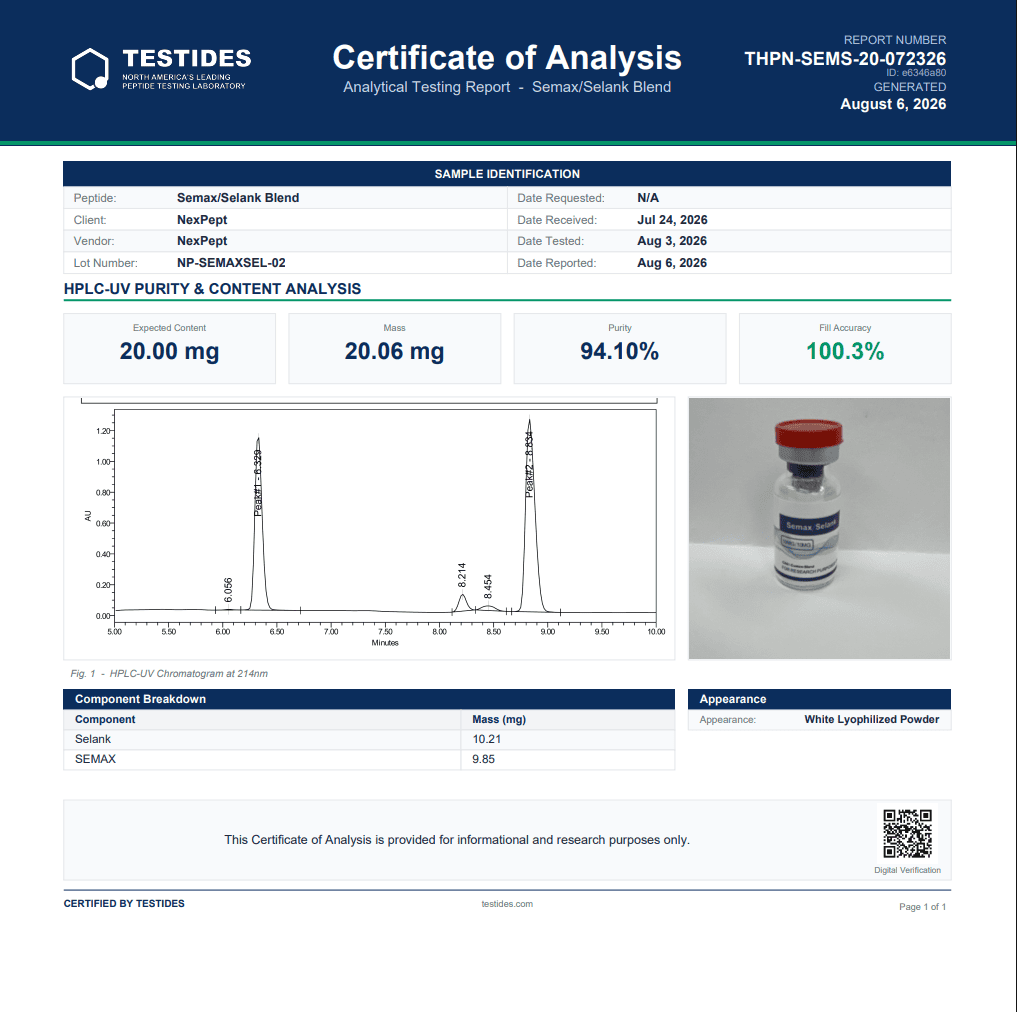
Independently tested for identity and purity
NP-SEMAXSEL-02
Aug 6, 2026
View Certificate of Analysis
Semax CAS# 80714-61-0
Selank CAS# 129954-34-3
Class Dual-Component Heptapeptide Nootropic / Anxiolytic Research Blend
Form Lyophilized Powder
Primary Research Targets
Blend Quantity
Composition
This blend pairs Semax (MEHFPGP, a synthetic heptapeptide derived from the ACTH(4-7) melanocortin sequence) and Selank (TKPRPGP, a synthetic analogue of the immunomodulatory tetrapeptide tuftsin) in equal 10 mg portions, combining their complementary neuromodulatory research profiles in a single lyophilised vial. The two peptides approach overlapping areas of neuroscience research from structurally and mechanistically distinct angles: Semax engages melanocortin receptor 4 (MC4R) to drive cAMP/PKA signalling and upregulate BDNF and NGF expression, while Selank modulates GABAergic tone and serotonergic/dopaminergic balance with associated BDNF upregulation and immunomodulatory effects on IL-6 and TGF-β. Despite these different N-terminal pharmacophores, both peptides are unified by an identical C-terminal Pro-Gly-Pro (PGP) extension that confers carboxypeptidase resistance and itself functions as a bioactive BDNF-derived fragment — creating a shared structural bridge of mechanistic relevance. Researchers apply this combination to paradigms where concurrent MC4R engagement and GABAergic modulation are of interest, to BDNF pathway studies where both peptides converge independently on the same downstream target, and to anxiety–cognition interaction models in which the anxiolytic and nootropic axes are explored together.
Molecular Profile
per-component CAS · sequence · formula · molecular weight
per-component CAS · sequence · formula · molecular weight
Semax
10 mg
Met-Glu-His-Phe-Pro-Gly-Pro
Selank
10 mg
Thr-Lys-Pro-Arg-Pro-Gly-Pro
| Blend Property | Detail |
|---|---|
| Total Peptide Content | 20 mg (10 mg Semax + 10 mg Selank per vial) |
| Shared Structural Motif | C-terminal Pro-Gly-Pro (PGP) on both peptides — carboxypeptidase resistance; bioactive BDNF fragment identity |
| Combined Residue Count | 14 AA total (7 + 7); both heptapeptides |
| Physical Form | Co-lyophilised powder; verify per-component content against Certificate of Analysis |
In Vitro Research Context
shared PGP motif · MC4R axis · GABAergic modulation · BDNF convergence
shared PGP motif · MC4R axis · GABAergic modulation · BDNF convergence
Both Semax (MEHFPGP) and Selank (TKPRPGP) terminate in the identical Pro-Gly-Pro (PGP) tripeptide — a sequence derived from the C-terminus of brain-derived neurotrophic factor (BDNF) that was grafted onto both scaffolds to improve metabolic stability. The Pro residues at C-terminus create a steric barrier to carboxypeptidase-mediated cleavage, substantially extending biological half-life relative to the parent sequences (ACTH(4-7) and tuftsin) while the PGP tripeptide itself is recognised as a bioactive BDNF fragment capable of activating TrkB signalling independently. This shared C-terminal architecture means that despite divergent N-terminal pharmacophores — the MEH- melanocortin sequence in Semax engaging MC4R and the TKP- tuftsin sequence in Selank engaging GABAergic and immunomodulatory pathways — both components converge on BDNF/TrkB pathway upregulation through both the PGP motif and independent receptor-mediated mechanisms. The blend therefore provides a dual-input BDNF stimulation model alongside distinct and complementary primary receptor axes.
Semax’s MEHFPGP sequence positions the His-Phe dipeptide of ACTH(4-7) for selective engagement of melanocortin receptor 4 (MC4R), a Class A GPCR with strong neuronal expression in the hypothalamus, frontal cortex, and hippocampus. MC4R binding drives Gαs → adenylyl cyclase → cAMP → PKA signalling, downstream of which BDNF and NGF expression have been observed to increase in cell culture and rodent brain homogenate models. The N-terminal Met¹ carries an oxidation liability (Met sulfoxide formation) relevant to long-term aqueous storage; the His³ residue coordinates metal ions (particularly Zn²⁺ and Cu²⁺) and should be considered when designing metal-containing buffer assay systems. Semax preclinical models span melanocortin receptor pharmacology, BDNF/NGF pathway modulation, serotonergic and dopaminergic pathway interaction assays, and oxidative stress paradigms.
Selank’s TKPRPGP sequence is built on the tuftsin scaffold (Thr-Lys-Pro-Arg), a tetrapeptide derived from the Fc fragment of IgG that was originally characterised as an immunomodulatory phagocytosis-stimulating factor. The PGP extension converts the rapidly degraded tuftsin fragment into a stable heptapeptide with central nervous system activity. In neuronal cell models and rodent CNS assays, Selank has been associated with positive allosteric modulation of GABA-A receptors, upregulation of serotonin uptake carrier expression, and modulation of IL-6 and TGF-β1 — positioning it as a research tool for anxiolytic pathway models, serotonin/norepinephrine transporter studies, and neuroimmune pathway investigations. Selank carries no Met or oxidation-prone residues; the Arg guanidinium group is stable under physiological conditions. The Lys residue is a potential ε-amine reactive site in aldehyde-based crosslinking assays and should be considered in reagent selection.
MC4R binding and cAMP accumulation assays (Semax); GABA-A allosteric modulation studies (Selank); receptor co-expression model design for dual-axis pharmacology; selectivity profiling against MC1R/MC3R and GABA-B.
Dual-input BDNF upregulation models — Semax via MC4R/cAMP axis, Selank via GABAergic modulation, both via shared PGP fragment; TrkB phosphorylation and downstream MAPK/PI3K assays; NGF expression profiling in neuronal cell lines.
Serotonin and dopamine transporter expression studies (Selank); monoamine metabolism assays in prefrontal cortex and hippocampal cell models; norepinephrine reuptake pathway interaction; combined MC4R/serotonin axis cross-talk models.
Selank IL-6 / TGF-β1 modulation in glial and macrophage models; Semax antioxidant pathway and superoxide dismutase expression assays; neuroinflammation marker profiling in LPS-stimulated cell models; combined neuroprotection paradigms.
Available Formats
blend composition · physical form · purity specification
blend composition · physical form · purity specification
| Component | Amount | Physical Form | Purity | Storage |
|---|---|---|---|---|
| Semax | 10 mg | Co-lyophilised powder | ≥98% | −20 °C |
| Selank | 10 mg | ≥98% |
Blend verification: Per-component mass (10 mg Semax + 10 mg Selank) is nominal. Confirm individual peptide content and purity against the Certificate of Analysis for each batch prior to research use. HPLC and MS data available upon request.
Laboratory Storage
lyophilised · reconstituted · component-specific stability
lyophilised · reconstituted · component-specific stability
| Condition | Guidance |
|---|---|
| Long-Term (Lyophilised) | −20 °C or below, desiccated, protected from light; stable for ≥24 months as lyophilised blend |
| Short-Term (Lyophilised) | 4 °C for up to 4 weeks; minimise temperature cycling |
| Reconstituted Solutions | Store at −20 °C in single-use aliquots; avoid repeated freeze-thaw cycles; use within 2–4 weeks if kept at 4 °C |
| Semax — Met¹ Oxidation | N-terminal Met of Semax is susceptible to sulfoxide formation in the presence of dissolved oxygen or peroxides; use degassed or argon-purged vehicles for aqueous solutions; avoid H₂O₂-containing buffers |
| Semax — His³ Metal Binding | His³ imidazole coordinates Zn²⁺, Cu²⁺, and Fe³⁺; avoid metal-containing buffers when Semax receptor binding fidelity is required; use chelation-free PBS or HEPES |
| Selank — General Stability | No Met, Trp, or Cys residues; Selank component is more oxidatively stable than Semax; Lys ε-amine is reactive with aldehydes — avoid glutaraldehyde-containing fixatives in cell-based assays |
| Light Sensitivity | Phe⁴ (Semax) and Arg⁴ (Selank) are not photosensitive; protect from UV exposure as routine precaution for peptide solutions |
Reconstitution note: For assays requiring independent concentration control of each peptide, consider sourcing Semax and Selank as separate vials. The blend formulation is suited to combined-exposure paradigms where a fixed 1:1 molar-ratio equivalent is appropriate for the research design.
Research Literature
selected references · Semax · Selank · melanocortin · GABA pharmacology
selected references · Semax · Selank · melanocortin · GABA pharmacology
Dolotov et al. (2001) / Eremin et al. (2005) — Semax preclinical studies on BDNF and NGF expression in rat frontal cortex and hippocampus; MC4R-mediated pathway characterisation. See also PMID: 15918050 for Semax neuroprotective pathway modelling in rodent models.
Semenova et al. (2007) — Selank (tuftsin analogue) effects on anxiety-related behaviour, serotonin uptake, and GABAergic modulation in preclinical models. Bulletin of Experimental Biology and Medicine. PMID: 17125879. Key reference for Selank’s serotonergic and anxiolytic research context.
Metts et al. / Catania et al. — Melanocortin receptor pharmacology and MC4R CNS expression: foundational characterisation of the receptor target for Semax’s ACTH(4-7)-derived pharmacophore. See PMID: 15590779 for MC4R structural pharmacology context.
The Semax / Selank blend supplied by NexPept is intended exclusively for in vitro laboratory research and preclinical investigation. Neither component nor the combined blend is approved for human or veterinary administration in Canada or any other jurisdiction, and this material does not constitute a drug product, natural health product, or therapeutic agent.
Researchers are responsible for ensuring all use complies with applicable institutional biosafety protocols, ethics board requirements, and federal regulations. For full blend specifications, per-component analytical data, and batch documentation, refer to the Certificate of Analysis provided with each order.
Product page: nexpept.ca — Semax / Selank Research Peptide Overview
Be the first to review “SEMAX 10MG / SELANK 10MG”
Related products


Reviews
There are no reviews yet.