
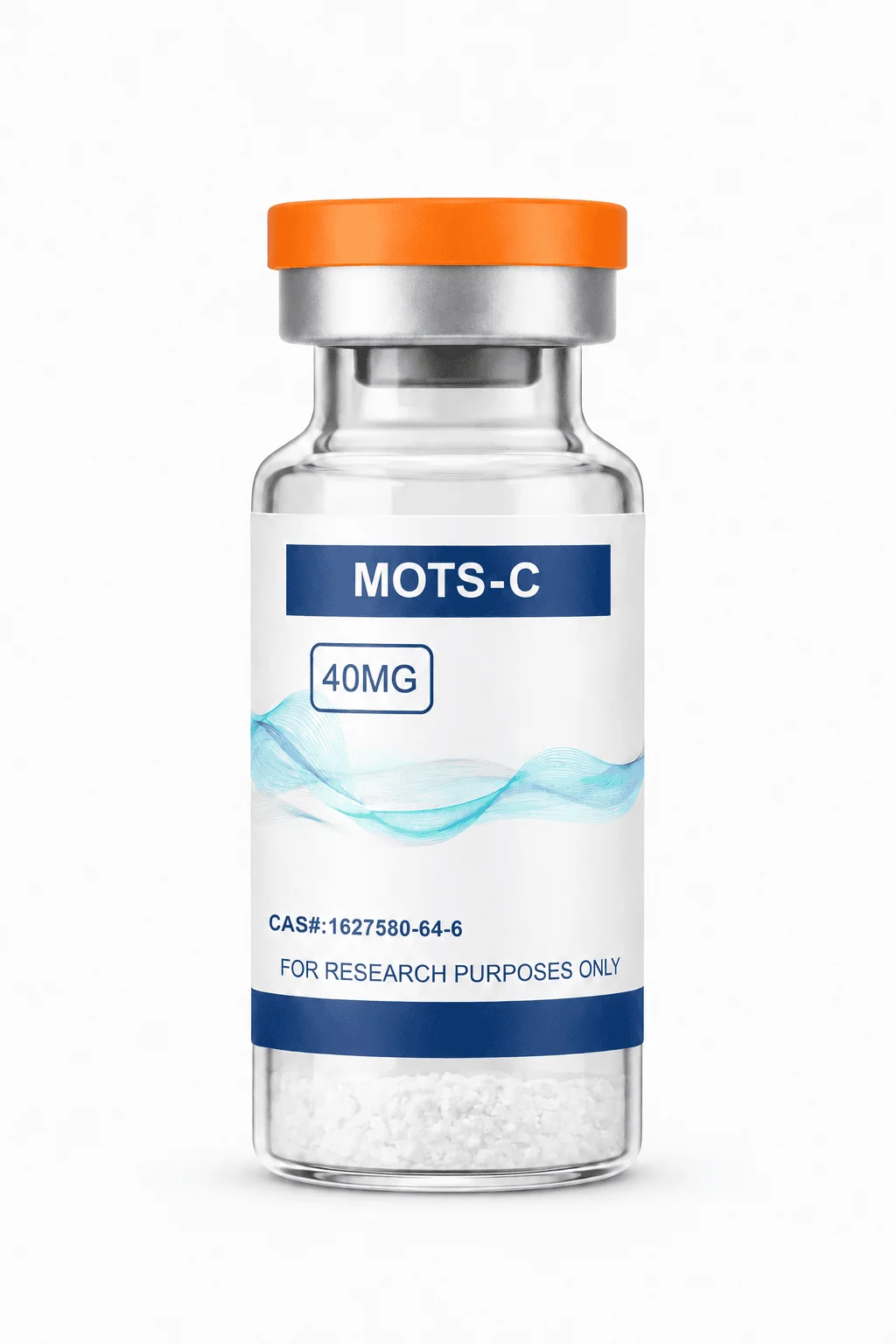
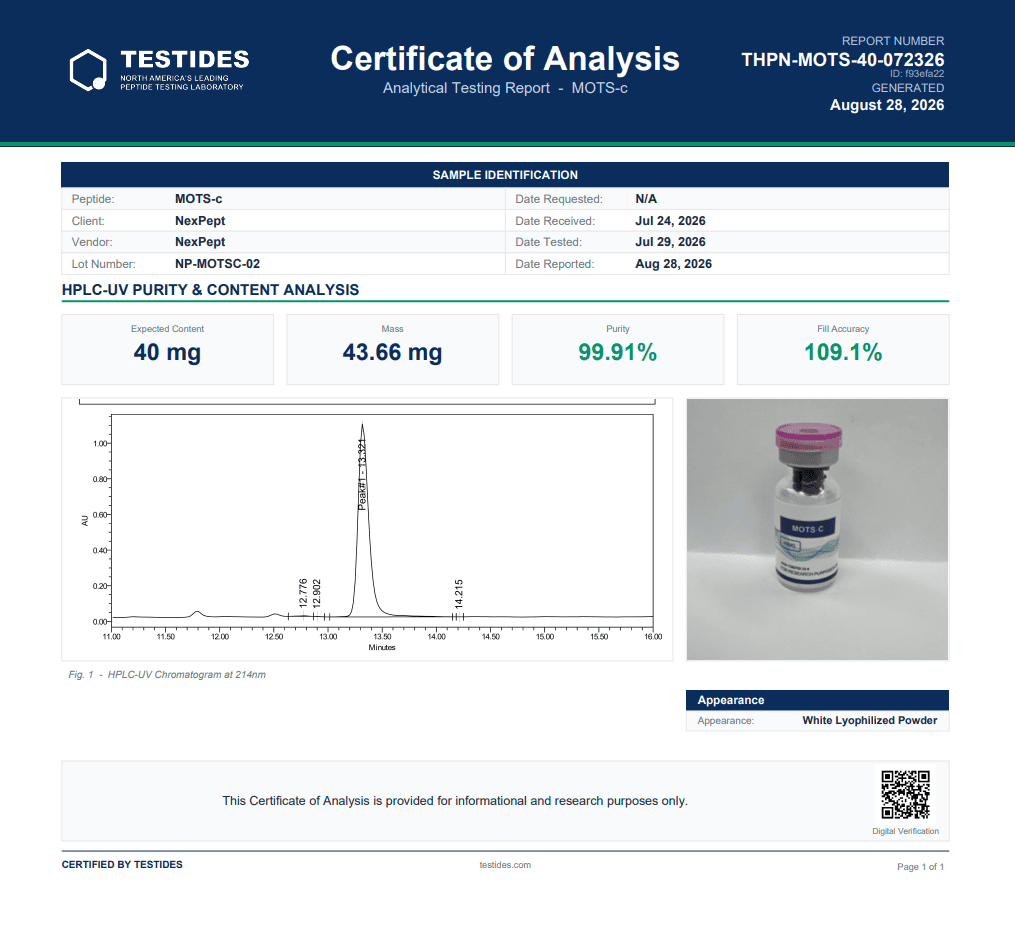


HPLC + MS
Independently tested for identity and purity
NP-MOTSC-02
Aug 28, 2026
99.91%
View Certificate of Analysis
CAS# 1627580-64-6
Origin Mitochondrial 12S rRNA Gene
Class Mitochondria-Derived Peptide (MDP)
Form Lyophilized Powder
Peptide Origin
Peptide Length
Molecular Weight
MOTS-C (Mitochondrial Open reading frame of the twelve S rRNA-c, CAS# 1627580-64-6) is a 16-amino-acid mitochondria-derived peptide (MDP) encoded within the 12S rRNA gene of mitochondrial DNA — making it one of a small class of bioactive peptides with a mitochondrial rather than nuclear genomic origin. MOTS-C is studied in preclinical research for its role in mitochondria-to-nucleus retrograde signalling and its involvement in AMPK pathway activation, the folate cycle, de novo purine synthesis, and metabolic regulation models. Under cellular stress conditions, MOTS-C has been shown to translocate from mitochondria to the nucleus in vitro, where it interacts with nuclear gene regulatory elements. Supplied by NexPept as a lyophilized powder for in vitro laboratory research use. This compound has not been authorized by Health Canada for any therapeutic, clinical, or human use.
Molecular Profile
CAS#, sequence, genomic origin, molecular weight
CAS#, sequence, genomic origin, molecular weight
| Property | Value |
|---|---|
| CAS Number | 1627580-64-6 |
| Full Name | Mitochondrial Open reading frame of the twelve S rRNA-c |
| Compound Class | Mitochondria-Derived Peptide (MDP) |
| Genomic Origin | Encoded within the 12S rRNA gene of mitochondrial DNA (mtDNA) — non-nuclear origin |
| Amino Acid Sequence | Met-Arg-Trp-Gln-Glu-Met-Gly-Tyr-Ile-Phe-Tyr-Pro-Arg-Lys-Leu-Arg (MRWQEMGYIFYPRKLR) |
| Sequence Length | 16 amino acids |
| Molecular Weight | ~2174.5 Da |
| Subcellular Localisation | Predominantly mitochondrial; translocates to nucleus under metabolic stress conditions in cellular models |
| Primary Research Targets | AMPK pathway; folate cycle; de novo purine synthesis; mitochondria–nucleus retrograde signalling |
| Physical Form | Lyophilized powder |
| Analytical Method | High-Performance Liquid Chromatography (HPLC) + Mass Spectrometry (MS) |
| Appearance | White to off-white lyophilized solid |
In Vitro Research Context
Mitochondria-derived signalling & metabolic pathway models — laboratory use only
Mitochondria-derived signalling & metabolic pathway models — laboratory use only
MOTS-C is exceptional among research peptides in that its coding sequence resides within the 12S rRNA gene of mitochondrial DNA — one of fewer than a dozen open reading frames (ORFs) in the entire mitochondrial genome known to encode functional peptides. Under conditions of metabolic stress in cellular models, MOTS-C has been demonstrated to translocate from the mitochondrial matrix to the nucleus, where it is proposed to interact with ARE (antioxidant response element) sequences and regulate nuclear gene expression. This mitochondria-to-nucleus communication pathway — retrograde signalling — is an active area of research with MOTS-C serving as a key model compound.
MOTS-C activates AMP-activated protein kinase (AMPK) in cellular models, engaging downstream metabolic signalling cascades including glucose uptake, fatty acid oxidation pathway regulation, and mitochondrial biogenesis signalling.
MOTS-C has been studied for its interaction with the folate cycle — specifically methionine cycle intermediates — providing a mechanistic link between mitochondrial metabolic state and one-carbon metabolism in vitro.
Inhibition of AICAR transformylase (ATIC) in the de novo purine synthesis pathway has been investigated as part of MOTS-C’s mechanism of metabolic pathway modulation in preclinical cellular research settings.
MOTS-C is studied in the context of insulin signalling and glucose metabolism pathway models, including PI3K/AKT cascade interactions and cellular glucose uptake assays in skeletal muscle cell models.
MOTS-C represents a structurally and mechanistically unique class of research peptide — one of only a small number of known mitochondria-derived peptides (MDPs) with a demonstrated role in inter-organelle signalling. Its dual role as both a mitochondrial product and a stress-responsive nuclear transcriptional modulator makes it a valuable tool compound for research at the intersection of metabolic biology, mitochondrial signalling, and gene regulation.
Research context: MOTS-C is an investigational mitochondria-derived peptide studied in scientific research involving AMPK pathway activation, mitochondrial retrograde signalling, and metabolic regulation models. It has not been authorized by Health Canada for human or veterinary use.
Available Formats
10mg and 40mg — lyophilized powder
10mg and 40mg — lyophilized powder
| Format | Net Quantity | Physical Form |
|---|---|---|
| MOTS-C 10mg | 10 mg / vial | Lyophilized powder |
| MOTS-C 40mg | 40 mg / vial | Lyophilized powder |
Sourced from a verified batch. Format selection should be based on the scale and duration of your specific in vitro research protocol, as determined by qualified research personnel.
Laboratory Storage
Controlled storage conditions for lyophilized material
Controlled storage conditions for lyophilized material
Store sealed lyophilized material under controlled laboratory conditions in accordance with validated institutional SOPs and applicable technical documentation. Protect from light and moisture. As a mid-sized 16-AA peptide containing methionine and tryptophan residues susceptible to oxidation, MOTS-C should be stored under inert or low-oxygen conditions where long-term stability is required. Handling conditions should be established by qualified research personnel in accordance with the specific experimental protocol.
Note: No preparation, reconstitution, or administration instructions are provided. This compound is supplied for in vitro laboratory research use only. All handling must be conducted by qualified personnel following institutional safety protocols.
Research Literature
Scientific references & related resources
Scientific references & related resources
MOTS-C Research Peptide Overview — NexPept compound overview and in vitro research context
PubMed — MOTS-C / Mitochondria-Derived Peptide — peer-reviewed literature on MOTS-C biology and metabolic signalling research
Research Peptides in Canada — sourcing and research context for Canadian laboratories
What Are Research Peptides? — peptide classification and in vitro research context
This product is supplied exclusively for in vitro laboratory and non-clinical research use by qualified research personnel. It is not authorized by Health Canada for human or veterinary use. No therapeutic, clinical, or health claims are made.
This material must not be administered to humans or animals. No dosage, preparation, reconstitution, or administration instructions are provided or implied. All handling and use must be conducted by qualified personnel in accordance with applicable institutional policies and legal requirements.
Be the first to review “MOTS-C 40mg”
Related products




Reviews
There are no reviews yet.