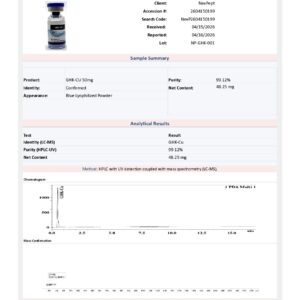
HPLC + MS
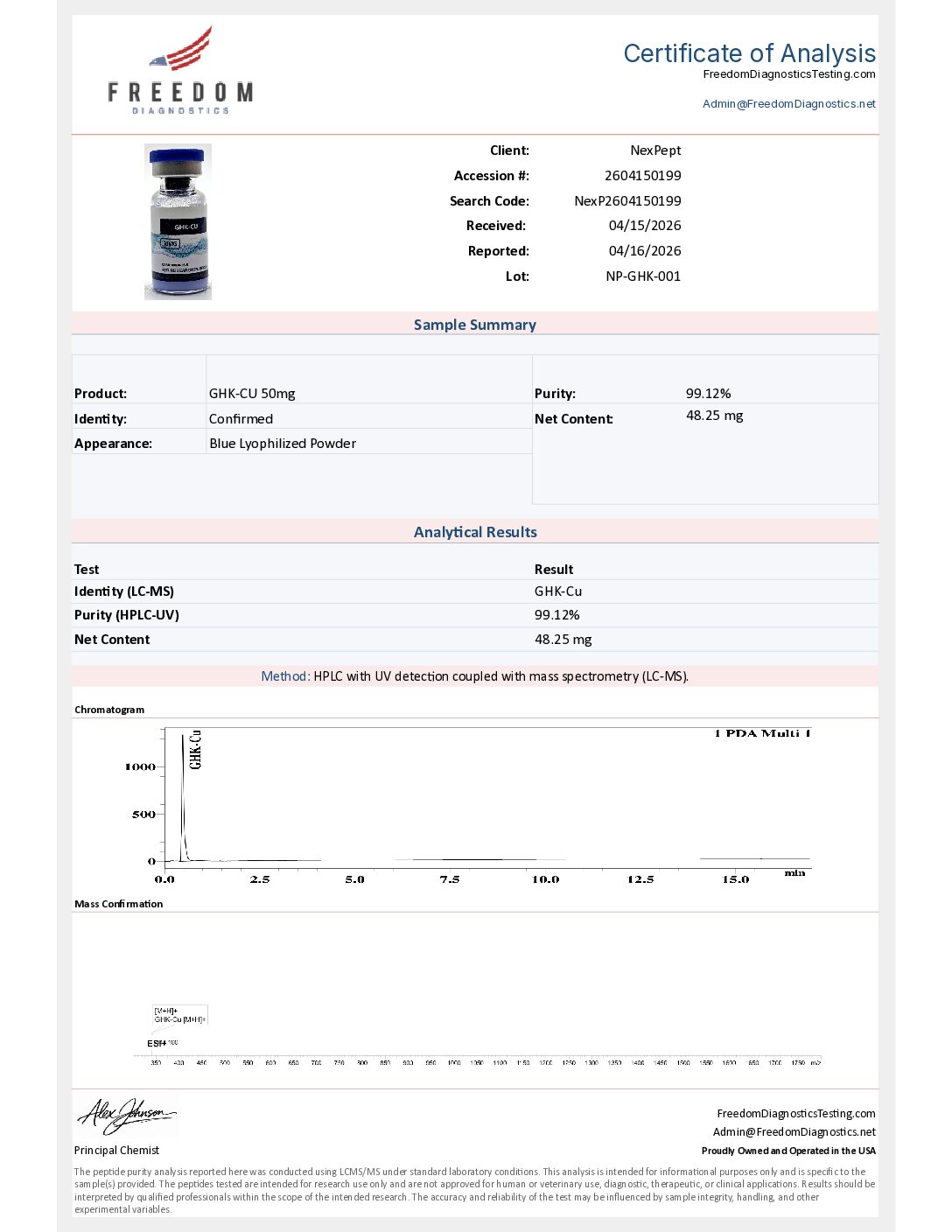
Independently tested for identity and purity
NP-GHK-001
Apr 16, 2026
99.12%
View Certificate of Analysis
CAS# 49557-75-7
Also Known As Copper Tripeptide-1
Class Endogenous Copper-Chelating Tripeptide
Form Lyophilized Powder
Classification
Peptide Length
Molecular Weight
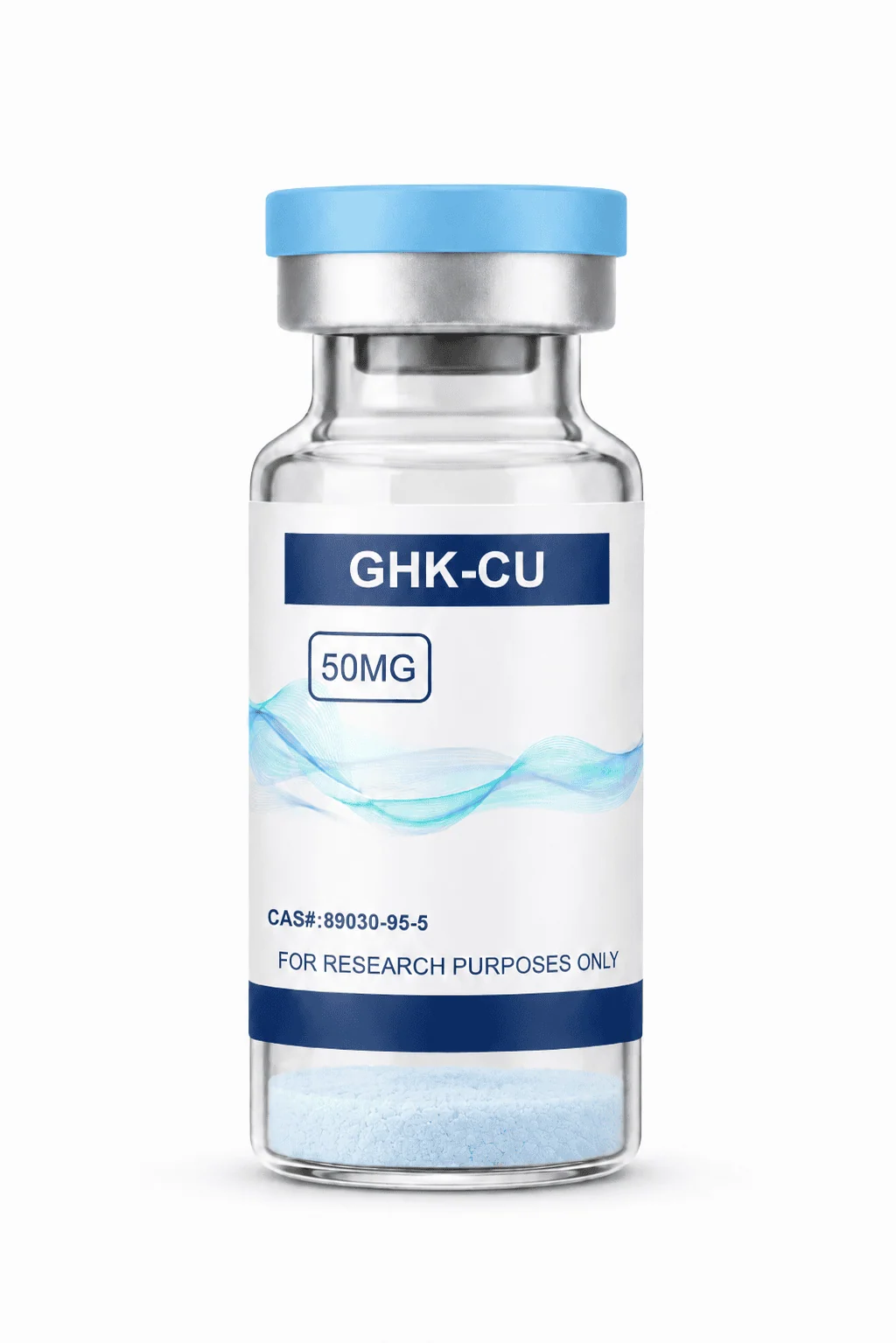
GHK-Cu (Glycyl-L-histidyl-L-lysine copper(II) complex, CAS# 49557-75-7) is an endogenous tripeptide–copper(II) coordination complex naturally occurring in human plasma, urine, and saliva. Comprising the tripeptide Gly-His-Lys chelated to a Cu²⁺ ion through its glycine amine, histidine imidazole, and deprotonated backbone nitrogen, GHK-Cu forms a high-affinity copper(II) complex with a distinctive blue colour in solution. It is studied in preclinical research across multiple cellular signalling contexts, including extracellular matrix remodelling, fibroblast activity models, copper transport and chaperone studies, and broad gene expression modulation assays. Supplied by NexPept as a lyophilized powder for in vitro laboratory research use. This compound has not been authorized by Health Canada for any therapeutic, clinical, or human use.
Molecular Profile
CAS#, sequence, copper coordination, molecular weight
CAS#, sequence, copper coordination, molecular weight
| Property | Value |
|---|---|
| CAS Number | 49557-75-7 |
| Common Name | Copper Tripeptide-1; GHK-Cu; Copper Peptide |
| Tripeptide Sequence | Gly-His-Lys (Glycine – Histidine – Lysine) |
| Compound Class | Endogenous copper(II)-chelating tripeptide complex |
| Peptide Origin | Endogenous — found in human plasma, urine, and saliva |
| Sequence Length | 3 amino acids |
| Molecular Formula | C₁₄H₂₃N₆O₄ · Cu (copper complex) |
| Molecular Weight | ~403.9 Da (Cu²⁺ coordination complex) |
| Copper Coordination | Cu²⁺ chelated via glycine α-amine, histidine imidazole nitrogen, and deprotonated backbone amide nitrogen (square-planar geometry) |
| Appearance | Blue to blue-green lyophilized solid (characteristic of Cu²⁺ coordination) |
| Physical Form | Lyophilized powder |
| Analytical Method | High-Performance Liquid Chromatography (HPLC) + Mass Spectrometry (MS) |
In Vitro Research Context
Copper biology & cellular pathway models — laboratory use only
Copper biology & cellular pathway models — laboratory use only
GHK-Cu coordinates copper(II) in a square-planar complex, forming one of the highest-affinity endogenous copper-binding peptides identified in human plasma. The Cu²⁺ ion is held by the glycine terminal amine, the histidine imidazole nitrogen at Nτ, and the deprotonated amide nitrogen of the Gly-His peptide bond — a 3N coordination geometry studied extensively in metal-peptide interaction research. This copper-carrying capacity makes GHK-Cu relevant to copper transport and chaperone pathway research in cellular models, where intracellular copper delivery mechanisms are investigated.
GHK-Cu is studied in fibroblast cell models for its effects on collagen and elastin gene expression, ECM remodelling pathways, and matrix metalloproteinase (MMP) regulation in vitro.
Studied as a model compound for copper(II) chaperone activity and intracellular copper delivery mechanisms, including interactions with copper-dependent enzymes in cell-based assays.
In vitro transcriptomic studies have identified GHK-Cu as a modulator of broad gene expression networks, including genes involved in cellular repair pathways, oxidative stress response, and inflammation signalling cascades.
Used in preclinical cellular models investigating fibroblast proliferation, keratinocyte migration, and angiogenic pathway activity in scratch assay and wound healing research settings.
GHK-Cu is among the most extensively studied endogenous copper-binding peptides in preclinical research, with a literature base spanning fibroblast biology, copper enzyme activation, ECM modelling, and broad transcriptomic studies. Unlike receptor-targeted peptides, its research utility is characterised by pleiotropic cellular signalling interactions mediated through copper delivery and direct peptide–cell interactions, making it a broadly applicable tool compound for in vitro cellular biology research.
Research context: GHK-Cu is an endogenous investigational copper-chelating tripeptide studied in scientific research involving copper biology, extracellular matrix pathway models, and gene expression modulation. It has not been authorized by Health Canada for human or veterinary use.
Available Formats
50mg and 100mg — lyophilized powder
50mg and 100mg — lyophilized powder
| Format | Net Quantity | Physical Form |
|---|---|---|
| GHK-Cu 50mg | 50 mg / vial | Lyophilized powder |
| GHK-Cu 100mg | 100 mg / vial | Lyophilized powder |
Sourced from a verified batch. Format selection should be based on the scale and duration of your specific in vitro research protocol, as determined by qualified research personnel.
Laboratory Storage
Controlled storage conditions for lyophilized material
Controlled storage conditions for lyophilized material
Store sealed lyophilized material under controlled laboratory conditions in accordance with validated institutional SOPs and applicable technical documentation. Protect from light and moisture. As a metal coordination complex, GHK-Cu should be stored in inert containers to prevent redox interactions. The characteristic blue colour of GHK-Cu in solution is normal and indicative of intact Cu²⁺ coordination; colour changes may indicate degradation or reduction of the copper centre. Handling conditions should be established by qualified research personnel in accordance with the specific experimental protocol.
Note: No preparation, reconstitution, or administration instructions are provided. This compound is supplied for in vitro laboratory research use only. All handling must be conducted by qualified personnel following institutional safety protocols.
Research Literature
Scientific references & related resources
Scientific references & related resources
GHK-Cu Research Peptide Overview — NexPept compound overview and in vitro research context
PubMed — GHK-Cu / Copper Tripeptide-1 — peer-reviewed scientific literature on copper peptide biology and cellular signalling
Research Peptides in Canada — sourcing and research context for Canadian laboratories
What Are Research Peptides? — peptide classification and in vitro research context
This product is supplied exclusively for in vitro laboratory and non-clinical research use by qualified research personnel. It is not authorized by Health Canada for human or veterinary use. No therapeutic, clinical, or health claims are made.
This material must not be administered to humans or animals. No dosage, preparation, reconstitution, or administration instructions are provided or implied. All handling and use must be conducted by qualified personnel in accordance with applicable institutional policies and legal requirements.
Be the first to review “GHK-Cu 50mg”
Related products
Peptides
Reviews
There are no reviews yet.