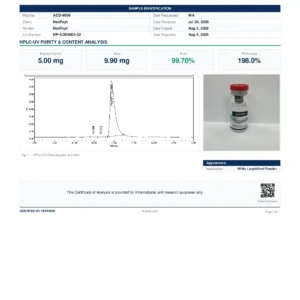
HPLC + MS
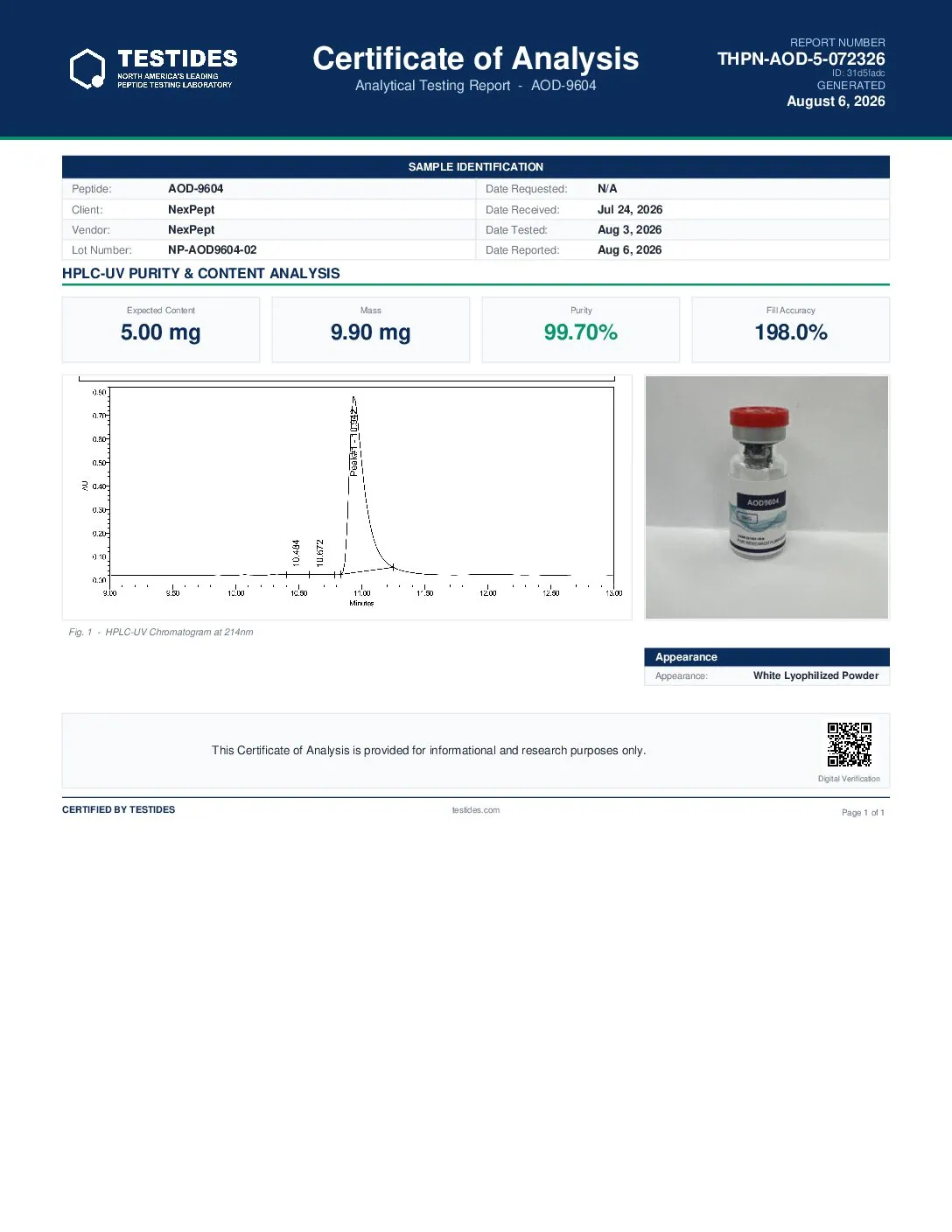
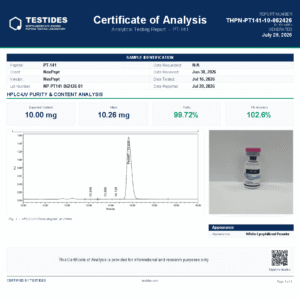
Independently tested for identity and purity
NP-AOD9604-02
Aug 6, 2026
99.70%
View Certificate of Analysis
CAS# 221231-10-3
Also Known As hGH Fragment 176–191
Class Synthetic Peptide
Form Lyophilized Powder
Receptor Target
Research Model
Sequence Length
AOD-9604 (hGH Fragment 176–191, CAS# 221231-10-3) is a synthetic peptide corresponding to the C-terminal region of human growth hormone (hGH), spanning residues 176 to 191. The compound retains a disulfide bridge between its two cysteine residues, preserving a structural feature of the native hGH C-terminus. It is studied as a pharmacological tool for investigating lipolytic signalling, β3-adrenergic receptor interactions, and adipocyte biology in in vitro research models. Supplied by NexPept as a lyophilized powder for in vitro laboratory research use. This compound has not been authorized by Health Canada for any therapeutic, clinical, or human use.
Molecular Profile
CAS#, sequence, formula, molecular weight, analytical data
CAS#, sequence, formula, molecular weight, analytical data
| Property | Value |
|---|---|
| CAS Number | 221231-10-3 |
| Also Known As | hGH Fragment 176–191; Anti-Obesity Drug 9604 |
| Parent Protein | Human Growth Hormone (hGH) — C-terminal fragment, residues 176–191 |
| Sequence | Tyr-Leu-Arg-Ile-Val-Gln-Cys-Arg-Ser-Val-Glu-Gly-Ser-Cys-Gly-Phe-NH₂ |
| Molecular Formula | C₇₈H₁₂₃N₂₃O₂₃S₂ |
| Molecular Weight | ~1817 Da |
| Disulfide Bridge | Cys⁷–Cys¹⁴ intramolecular disulfide bond |
| Compound Class | Synthetic peptide — growth hormone-derived lipolytic fragment |
| Receptor Target | β3-Adrenergic receptor (β3-AR); lipolytic signalling pathway |
| Physical Form | Lyophilized powder |
| Analytical Method | High-Performance Liquid Chromatography (HPLC) + Mass Spectrometry (MS) |
| Appearance | White to off-white lyophilized solid |
In Vitro Research Context
Receptor pharmacology — laboratory use only
Receptor pharmacology — laboratory use only
Beta-3 adrenergic receptor — lipolytic cAMP signalling pathway research
In vitro adipocyte differentiation and lipid accumulation research models
Lipolytic activity independent of GH receptor and IGF-1 pathway studies
AOD-9604 is studied in preclinical in vitro settings as a pharmacological tool for investigating the lipolytic properties of the C-terminal region of human growth hormone, independently of GH receptor activation and IGF-1 axis signalling. Research applications include β3-adrenergic receptor binding assays, cAMP pathway activation studies, adipocyte lipolysis models, and transcriptomic analysis of lipid metabolism gene expression in adipose cell lines. The retention of the native Cys⁷–Cys¹⁴ disulfide bridge is studied for its role in maintaining the structural integrity of the lipolytic pharmacophore region.
Available Formats
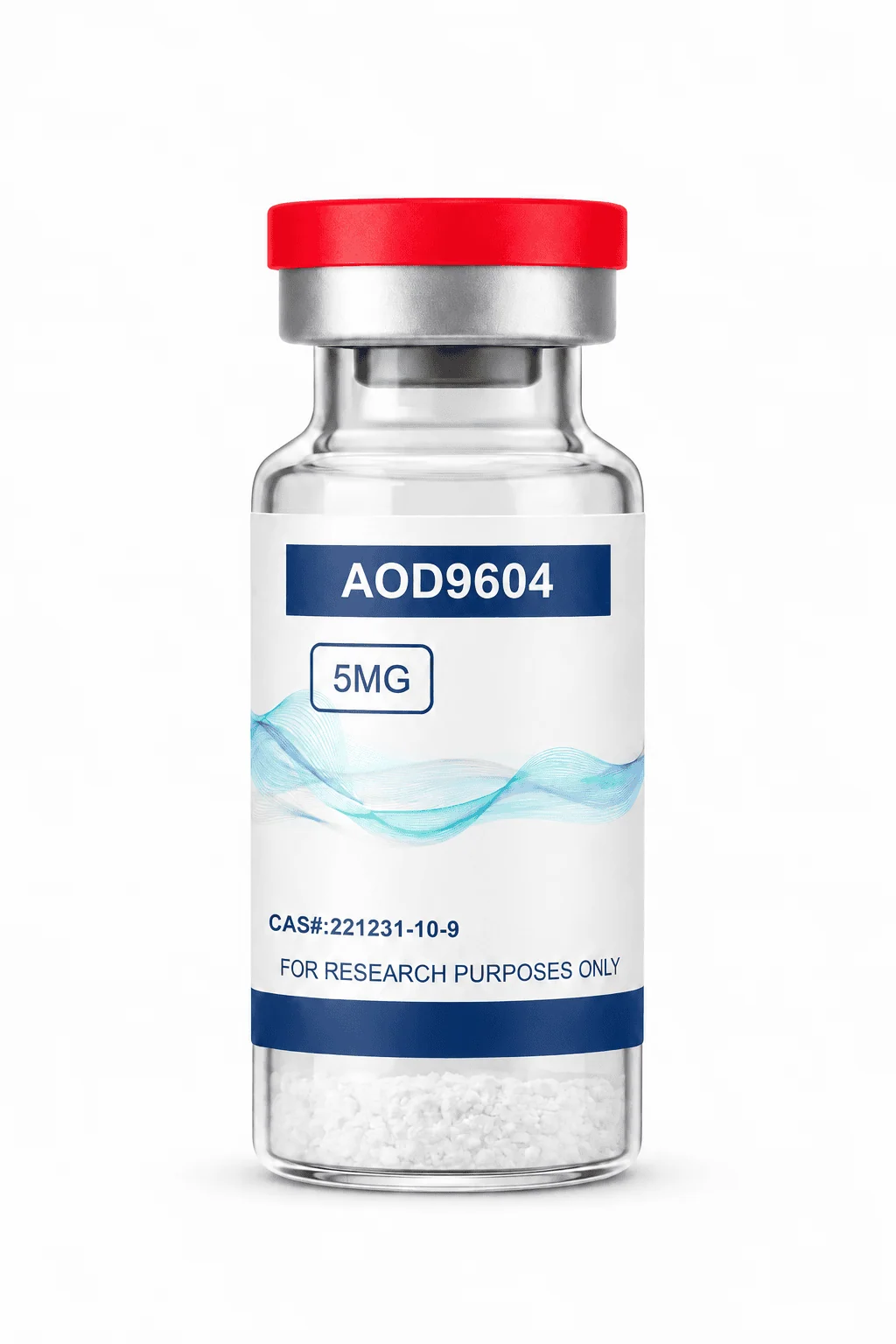
5mg — lyophilized powder
5mg — lyophilized powder
| Format | Net Quantity | Physical Form |
|---|---|---|
| AOD-9604 5mg | 5 mg / vial | Lyophilized powder |
Laboratory Storage
Controlled storage conditions for lyophilized material
Controlled storage conditions for lyophilized material
Store sealed lyophilized material under controlled laboratory conditions in accordance with validated institutional SOPs and applicable technical documentation. Protect from light and moisture. Handling conditions should be established by qualified research personnel in accordance with the specific experimental protocol.
Research Literature
Scientific references & related resources
Scientific references & related resources
PubMed — AOD-9604 / hGH Fragment 176–191 — peer-reviewed scientific literature on this compound
PubMed — GH Fragment Lipolytic Research — β3-AR and hGH C-terminal fragment pharmacology literature
Research Peptides in Canada — sourcing and research context for Canadian laboratories
What Are Research Peptides? — peptide classification and in vitro research context
This product is supplied exclusively for in vitro laboratory and non-clinical research use by qualified research personnel. It is not authorized by Health Canada for human or veterinary use. No therapeutic, clinical, or health claims are made.
This material must not be administered to humans or animals. No dosage, preparation, reconstitution, or administration instructions are provided or implied. All handling and use must be conducted by qualified personnel in accordance with applicable institutional policies and legal requirements.
Be the first to review “AOD-9604 5MG”
Related products
Reviews
There are no reviews yet.