HPLC + MS
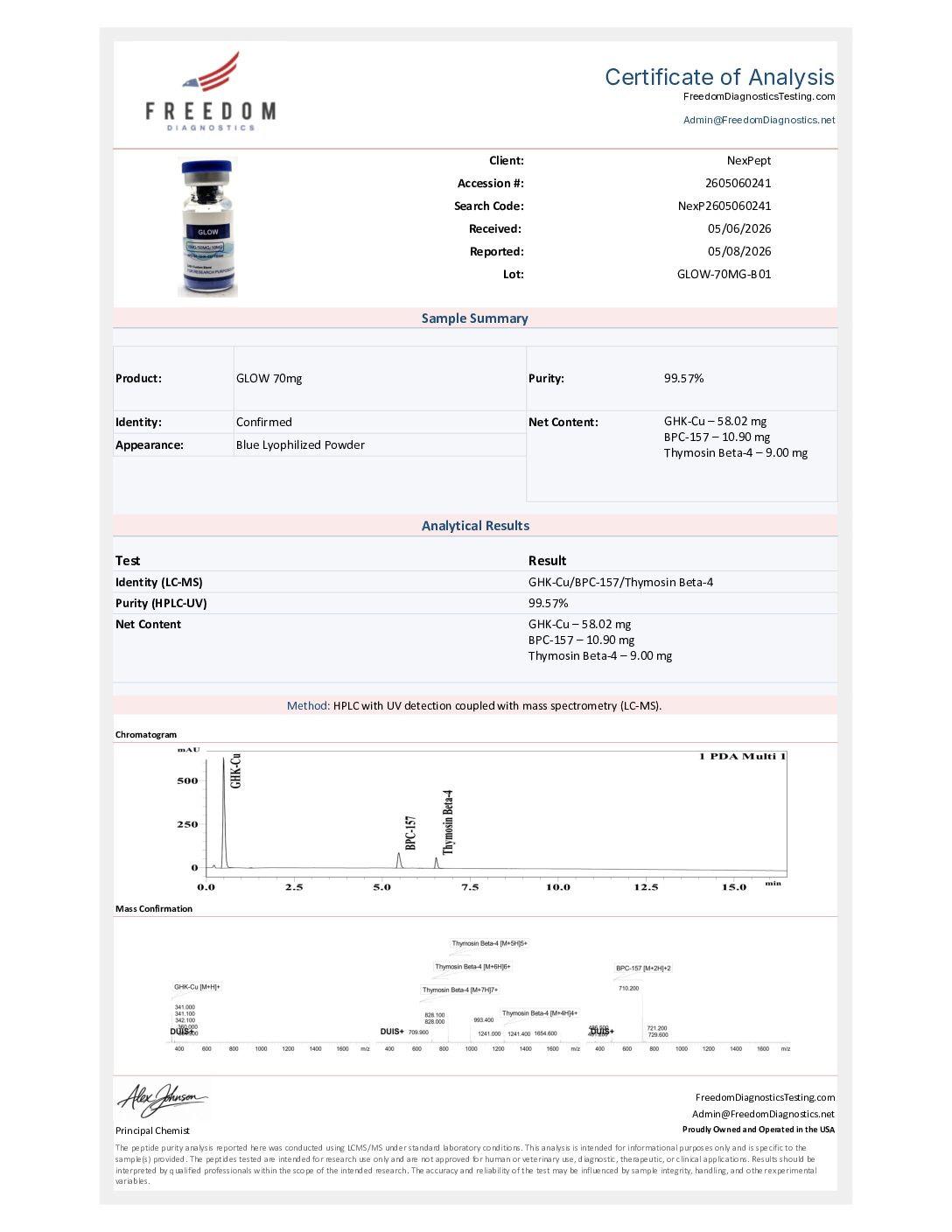
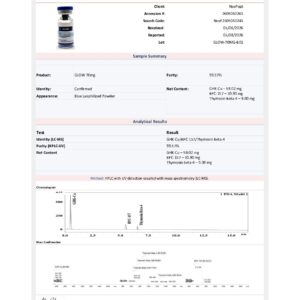
Independently tested for identity and purity
GLOW-70MG-B01
May 8, 2026
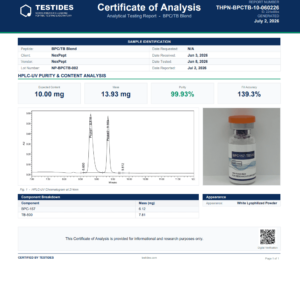
99.57%
View Certificate of Analysis
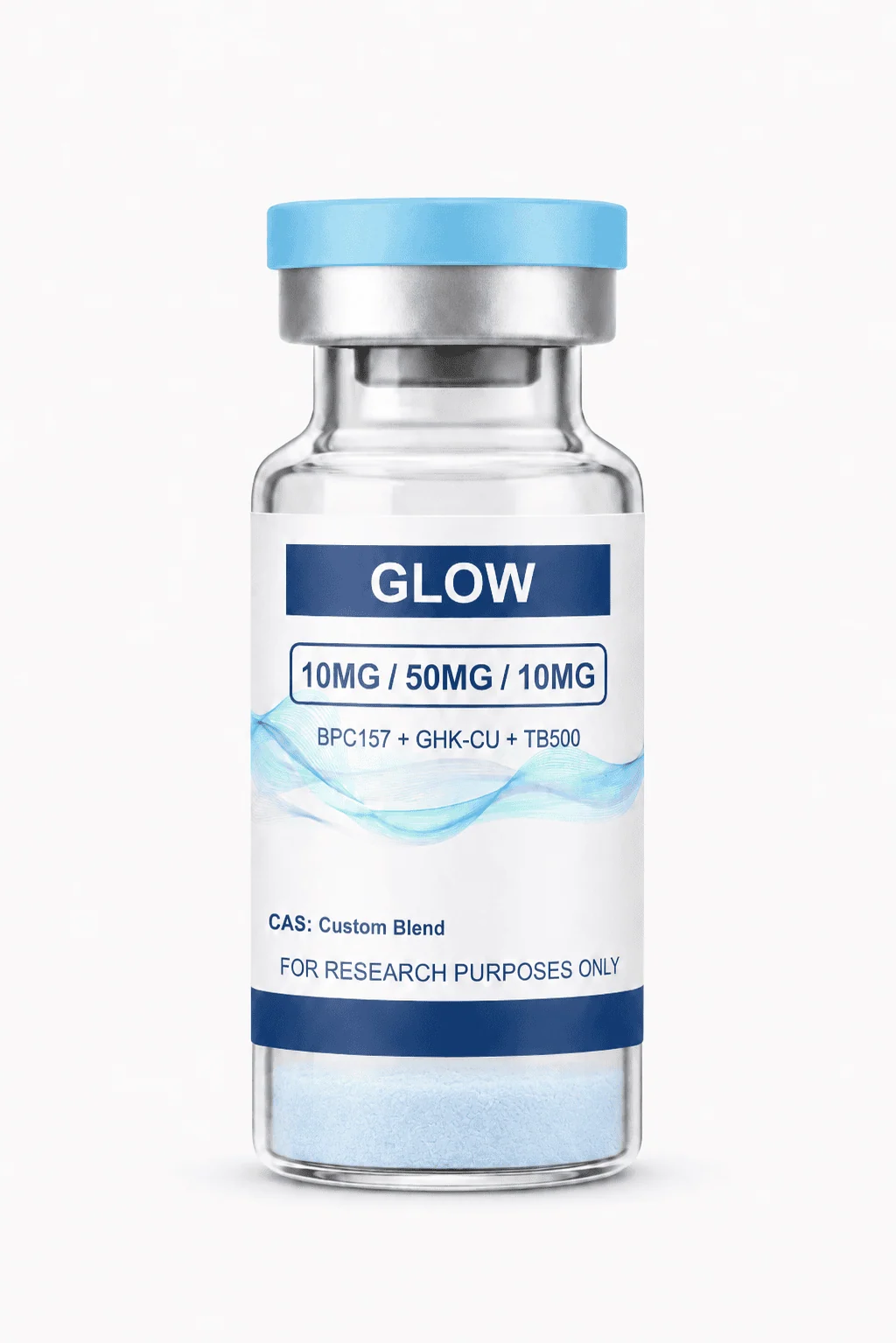
Components GHK-Cu / BPC-157 / TB-500
Total Quantity 70 mg
Class Triple-Peptide Research Blend
Form Lyophilized Powder
Research Targets
Net Quantity
Formulation
The Glow Blend is a triple-peptide research formulation combining GHK-Cu (Copper Tripeptide-1), BPC-157 (Body Protection Compound-157), and TB-500 (Thymosin Beta-4) in a single lyophilized vial. Each component engages distinct molecular targets — Cu²⁺-mediated gene expression and ECM pathway research (GHK-Cu), FAK-paxillin and VEGF signalling models (BPC-157), and G-actin sequestration and ILK pathway studies (TB-500) — making this blend a multi-target tool formulation for laboratory models investigating cellular signalling, matrix biology, and cytoskeletal dynamics. Supplied by NexPept as a lyophilized powder for in vitro laboratory research use. This product has not been authorized by Health Canada for any therapeutic, clinical, or human use.
Molecular Profile
CAS#, sequences, molecular weights & key properties for all three components
CAS#, sequences, molecular weights & key properties for all three components
GHK-Cu
Copper Tripeptide-1
CAS# 49557-75-7
Gly-His-Lys · Cu²⁺ complex
3 AA · ~403.9 Da
Target: Cu²⁺ coordination / ECM
50 mg
BPC-157
Body Protection Compound-157
CAS# 137525-51-0
Gly-Glu-Pro-Pro-Pro-Gly-Lys-Pro-Ala-Asp-Asp-Ala-Gly-Leu-Val
15 AA · ~1419.5 Da
Target: FAK-paxillin / VEGF / NO
10 mg
TB-500
Thymosin Beta-4
CAS# 77591-33-4
43-AA thymic peptide (LKKTET motif)
43 AA · ~4964 Da
Target: G-Actin / ILK / integrin
10 mg
| Property | GHK-Cu | BPC-157 | TB-500 |
|---|---|---|---|
| CAS Number | 49557-75-7 | 137525-51-0 | 77591-33-4 |
| Molecular Weight | ~403.9 Da | ~1419.5 Da | ~4964 Da |
| Amino Acids | 3 AA | 15 AA | 43 AA |
| Peptide Class | Endogenous Cu²⁺ complex | Synthetic gastric pentadecapeptide | Synthetic thymic peptide |
| Quantity per Vial | 50 mg | 10 mg | 10 mg |
| Physical Form | Co-lyophilized powder — single vial, 70 mg total | ||
| Analytical Method | HPLC + Mass Spectrometry (MS); verify against batch CoA | ||
Note: Component quantities listed (50 mg GHK-Cu / 10 mg BPC-157 / 10 mg TB-500) reflect formulation estimates. Verify exact per-component quantities against your batch Certificate of Analysis prior to use.
In Vitro Research Context
Per-component signalling targets & cellular research models — laboratory use only
Per-component signalling targets & cellular research models — laboratory use only
Copper Tripeptide-1 — ECM, Gene Expression & Copper Transport Models
GHK-Cu (Gly-His-Lys·Cu²⁺) is an endogenous tripeptide present in human plasma, wound fluid, and saliva. It coordinates Cu²⁺ in a square-planar geometry via the glycine α-amine, histidine imidazole Nτ nitrogen, and a deprotonated backbone amide. In cellular research models, GHK-Cu has been studied for its effects on extracellular matrix protein expression — including collagen, elastin, and fibronectin synthesis in fibroblast cell lines — as well as for its interactions with antioxidant pathways, copper chaperone proteins, and gene expression panels. Published in vitro literature includes wound-healing scratch assays, fibroblast proliferation studies, and gene array analyses examining GHK-Cu’s modulation of hundreds of downstream transcriptional targets.
Body Protection Compound-157 — FAK-Paxillin, NO Pathway & VEGF Research
BPC-157 is a synthetic 15-amino-acid pentadecapeptide derived from a sequence within the gastric protein BPC. In vitro research has examined its interactions with focal adhesion kinase (FAK) and paxillin signalling, nitric oxide (NO) pathway modulation in endothelial cell models, and VEGF-associated angiogenesis pathway studies in fibroblast and endothelial preparations. BPC-157 is also studied in gastrointestinal cellular models examining cytoprotective signalling, and in cell migration and proliferation assays across multiple cell line types.
Thymosin Beta-4 — G-Actin Sequestration, Cytoskeletal Dynamics & ILK Signalling
TB-500 (Thymosin Beta-4) is a synthetic 43-amino-acid thymic peptide and the primary G-actin sequestering agent in mammalian cells. Its central LKKTET motif (residues 17–22) inserts into the hydrophobic cleft between subdomains 1 and 3 of monomeric G-actin, blocking barbed-end polymerisation and modulating the G-actin/F-actin ratio. In vitro applications include actin cytoskeleton remodelling studies, scratch-wound (cell migration) assays, endothelial tube formation models, and ILK/integrin signalling experiments examining downstream AKT and GSK-3β phosphorylation in fibroblast and epithelial cell preparations.
The Glow Blend formulation combines three peptides with mechanistically distinct but potentially complementary research targets in cellular biology. GHK-Cu engages copper homeostasis and extracellular matrix gene expression pathways; BPC-157 interacts with focal adhesion and angiogenic signalling cascades; TB-500 modulates the actin cytoskeleton via direct G-actin sequestration and ILK-mediated outside-in integrin signalling. Researchers using this blend in multi-pathway assay designs should account for the distinct molecular weight and concentration profiles of each component when designing experimental controls.
Research context: The Glow Blend is an investigational multi-peptide research formulation studied in scientific research involving extracellular matrix biology, cellular signalling, and cytoskeletal dynamics models. It has not been authorized by Health Canada for human or veterinary use.
Available Formats
70 mg total (GHK-Cu / BPC-157 / TB-500) — lyophilized powder
70 mg total (GHK-Cu / BPC-157 / TB-500) — lyophilized powder
| Component | Quantity | Physical Form |
|---|---|---|
| GHK-Cu (Copper Tripeptide-1) | 50 mg | Co-lyophilized powder · single sterile vial · 70 mg total |
| BPC-157 | 10 mg | |
| TB-500 (Thymosin Beta-4) | 10 mg |
Sourced from a verified batch. Verify exact per-component quantities against the batch Certificate of Analysis prior to use. Quantity for use should be determined based on your specific in vitro research protocol by qualified research personnel.
Laboratory Storage
Controlled storage conditions for co-lyophilized blend material
Controlled storage conditions for co-lyophilized blend material
Store sealed lyophilized material under controlled laboratory conditions in accordance with validated institutional SOPs and applicable technical documentation. Protect from light and moisture. As a co-lyophilized blend, storage conditions must satisfy the most demanding requirements across all three components: GHK-Cu is susceptible to Cu²⁺ dissociation under highly acidic aqueous conditions and should be stored desiccated — discolouration of the powder may indicate Cu²⁺ complex degradation. BPC-157 and TB-500 are both subject to standard peptide oxidative and hydrolytic degradation pathways. Reconstituted aliquots should be used promptly; avoid repeated freeze-thaw cycles once the vial has been opened.
Note: No preparation, reconstitution, or administration instructions are provided. This compound is supplied for in vitro laboratory research use only. All handling must be conducted by qualified personnel following institutional safety protocols.
Research Literature
Scientific references & related resources
Scientific references & related resources
Glow Blend Research Peptide Overview — NexPept compound overview and in vitro research context
PubMed — GHK-Cu / Copper Tripeptide-1 — peer-reviewed literature on ECM signalling, gene expression, and fibroblast cell models
PubMed — BPC-157 — peer-reviewed literature on FAK-paxillin signalling, VEGF pathway, and cellular migration models
PubMed — TB-500 / Thymosin Beta-4 — peer-reviewed literature on G-actin sequestration, ILK signalling, and cytoskeletal dynamics
Research Peptides in Canada — sourcing and research context for Canadian laboratories
What Are Research Peptides? — peptide classification and in vitro research context
This product is supplied exclusively for in vitro laboratory and non-clinical research use by qualified research personnel. It is not authorized by Health Canada for human or veterinary use. No therapeutic, clinical, or health claims are made.
This material must not be administered to humans or animals. No dosage, preparation, reconstitution, or administration instructions are provided or implied. All handling and use must be conducted by qualified personnel in accordance with applicable institutional policies and legal requirements.
Be the first to review “GLOW BLEND 70MG”
Related products
Peptides
Reviews
There are no reviews yet.