
HPLC + MS
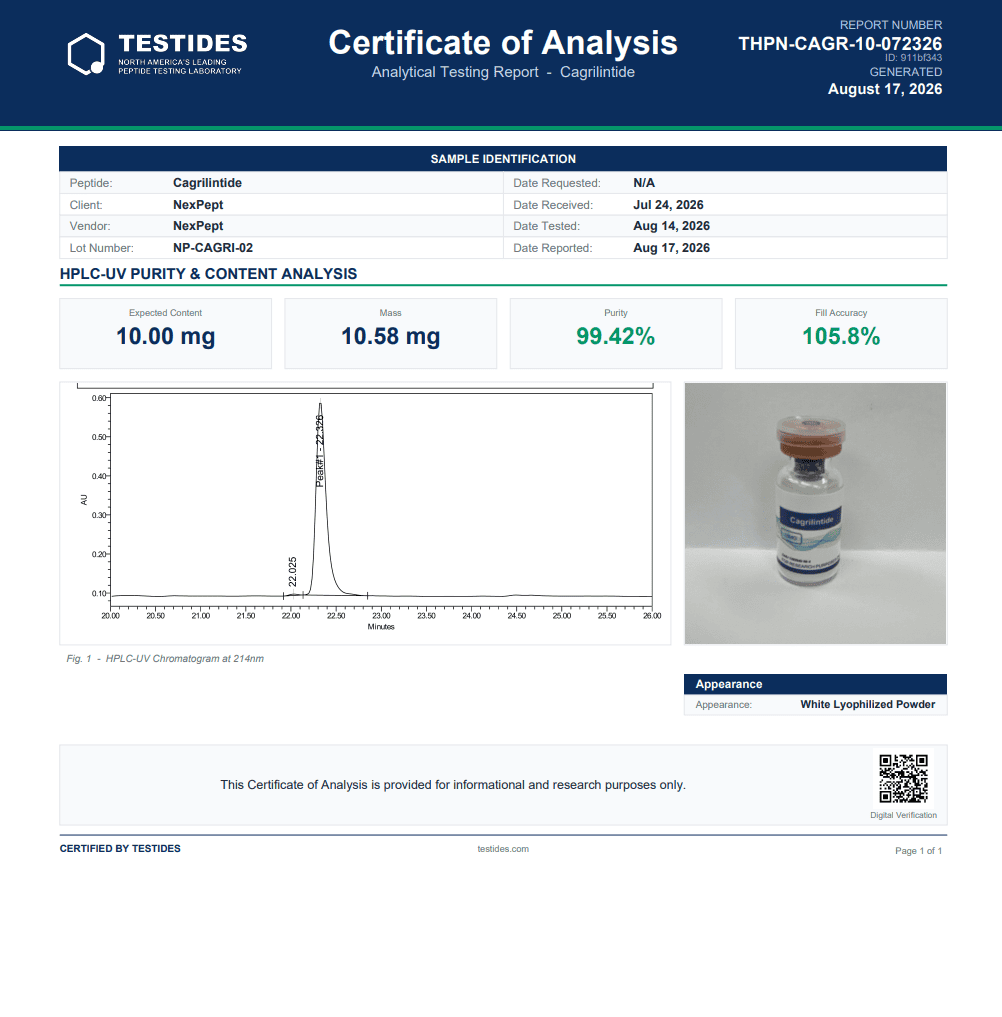
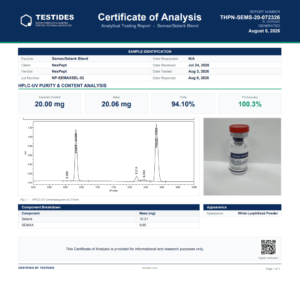
Independently tested for identity and purity
NP-CAGRI-02
Aug 17, 2026
99.42%
View Certificate of Analysis
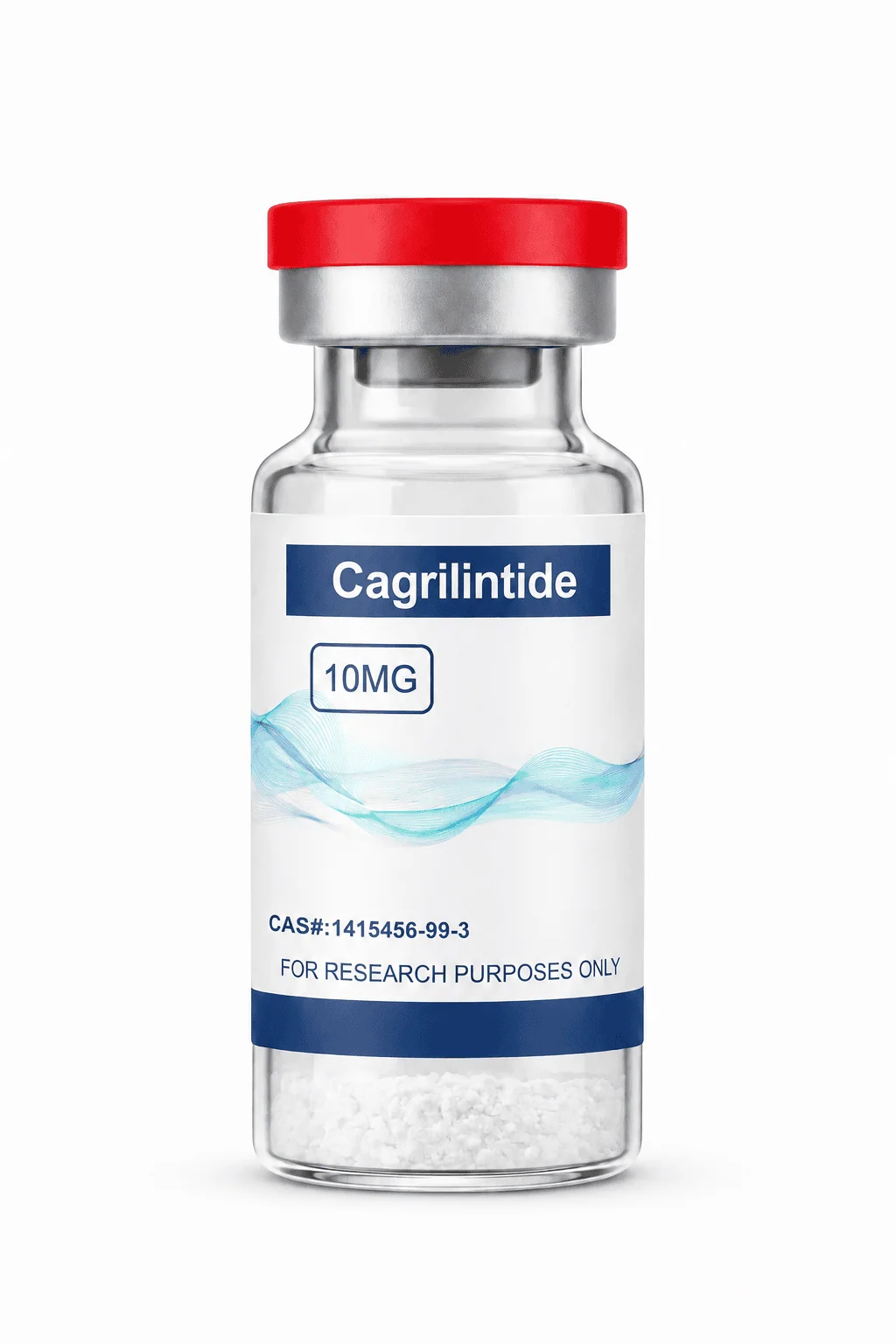
CAS# 1415456-99-3
Also Known As AM833; NN9838
Class Long-Acting Fatty Acid–Conjugated Amylin Analogue
Form Lyophilized Powder
Receptor Targets
Peptide Length
Molecular Weight
Cagrilintide (INN; also AM833 / NN9838) is a long-acting, fatty acid–conjugated analogue of human islet amyloid polypeptide (IAPP/amylin) engineered to preserve AMY1–3R agonist activity while eliminating the amyloidogenic liability intrinsic to native amylin. Human amylin’s hydrophobic core—the SSNNFGAILSS region spanning residues 20–29—is among the most amyloidogenic sequences known in biology, driving rapid fibril nucleation in vitro and associated with beta-cell toxicity in type 2 diabetes models. Cagrilintide incorporates targeted amino acid substitutions at these positions to disrupt β-sheet stacking without disrupting calcitonin receptor (CTR) / receptor activity–modifying protein (RAMP) heterodimer affinity. A C18 fatty diacid moiety conjugated via a γ-Glu–2×mini-PEG linker to a specific Lys side chain confers reversible, non-covalent albumin binding—the same albumin-buffering strategy employed by semaglutide—extending the effective half-life from the ~2-minute plasma half-life of native amylin to approximately seven days in preclinical models. In in vitro and preclinical in vivo contexts, cagrilintide has been applied to models of amylin receptor pharmacology, hypothalamic satiety circuitry, area postrema signalling, gastric motility inhibition, and—in combination with GLP-1R agonists—additive or synergistic metabolic pathway modulation (CagriSema preclinical paradigm).
Molecular Profile
CAS · structural class · receptor target · key modifications
CAS · structural class · receptor target · key modifications
| Property | Detail |
|---|---|
| CAS Number | 1415456-99-3 |
| INN / Code Name | Cagrilintide; AM833; NN9838 |
| Structural Class | 37-AA Human Amylin (IAPP) Analogue — Fatty Acid Conjugated |
| Molecular Weight | ~6,396 Da (approximate; refer to Certificate of Analysis) |
| Backbone Length | 37 Amino Acids |
| Receptor Targets | AMY1R, AMY2R, AMY3R (CTR + RAMP1/2/3 heterodimers); Calcitonin Receptor (CTR) |
| Receptor Class | Class B GPCR; Gαs-coupled (primary); secondary Gαq / calcium mobilisation |
| Terminus | Cys²–Cys⁷ disulfide bridge (conserved from native amylin); C-terminal amide |
| Anti-Amyloid Mods | Targeted substitutions at amyloidogenic core (residues 20–29; SSNNFGAILSS region) — Pro and other helix-breaking residues disrupt β-sheet stacking |
| PK-Extension Mods | C18 fatty diacid (octadecanedioic acid derivative) via γ-Glu–2×mini-PEG linker at Lys side chain → non-covalent albumin Cys-34 binding |
| Native Comparator | Human amylin (IAPP): KCNTATCATQRLANFLVHSSNNFGAILSSTNVGSNTY · ~3,903 Da · t½ ~2 min |
| Earlier Analogue | Pramlintide: 3×Pro substitutions (positions 25, 28, 29); no FA conjugation; t½ ~48 min; requires multiple daily injections |
In Vitro Research Context
AMY receptor pharmacology · anti-amyloid design · signalling cascades
AMY receptor pharmacology · anti-amyloid design · signalling cascades
Native human amylin is among the most amyloidogenic polypeptides in mammalian biology: its SSNNFGAILSS core (residues 20–29) initiates nucleated polymerisation into cross-β amyloid fibrils within minutes under physiological conditions in vitro, complicating cell-based receptor assays and rendering native amylin unsuitable for chronic in vivo dosing paradigms. Cagrilintide replaces key β-sheet-nucleating residues in this region with Pro or other helix-disrupting substitutions, abolishing fibril formation kinetics while preserving CTR/RAMP heterodimer binding affinity. The retained Cys²–Cys⁷ disulfide and C-terminal amide maintain the structural epitopes required for AMY1–3R recognition. Separately, a C18 fatty diacid is attached at a specific Lys side chain via a bifunctional γ-Glu–2×OEG (mini-PEG) linker—the identical albumin-binding strategy employed by semaglutide at its Lys²⁶ residue. This modification exploits the ~560 µM affinity of long-chain fatty acids for albumin Cys-34, creating a depot-like reservoir that buffers free peptide concentration and extends the plasma half-life from ~2 minutes (native amylin) to ~7 days in preclinical studies, enabling once-weekly research dosing regimens.
Structural evolution of amylin analogues in preclinical and clinical research:
| Analogue | Length | Anti-Amyloid Strategy | PK Extension | Half-Life Profile |
|---|---|---|---|---|
| Native Amylin (IAPP) | 37 AA | None — highly amyloidogenic | None | ~2 min |
| Pramlintide | 37 AA | Pro25, Pro28, Pro29 substitutions | None | ~48 min |
| Cagrilintide ★ | 37 AA | Multi-position substitutions at amyloidogenic core | C18 diacid via γ-Glu–2×OEG linker | ~7 days |
AMY1R / AMY2R / AMY3R binding affinity studies; CTR + RAMP1/2/3 heterodimer assembly characterisation; receptor selectivity profiling vs calcitonin; competitive radioligand displacement assays.
AMY receptor Gαs → adenylyl cyclase → cAMP → PKA pathway; secondary Gαq → PLC → IP₃ / Ca²⁺ flux in area postrema and NTS cell models; β-arrestin recruitment assays.
Area postrema and nucleus tractus solitarius (NTS) receptor density studies; neuropeptide modulation models (NPY, AgRP, POMC expression); gastric motility inhibition and emptying-rate assays.
Glucagon suppression assays; islet beta-cell co-secretion models; GLP-1R / AMY co-agonism synergy paradigms (CagriSema preclinical context); dose–response characterisation in metabolic pathway studies.
Available Formats
vial sizes · physical form · purity specification
vial sizes · physical form · purity specification
| Format | Amount | Physical Form | Purity | Storage |
|---|---|---|---|---|
| Cagrilintide | 10 mg | Lyophilised powder | ≥98% | −20 °C |
Purity verification: Each batch is characterised by HPLC and mass spectrometry. Certificate of Analysis available upon request. Confirm molecular weight and purity against CoA prior to research use.
Laboratory Storage
lyophilised · reconstituted · stability considerations
lyophilised · reconstituted · stability considerations
| Condition | Guidance |
|---|---|
| Long-Term (Lyophilised) | −20 °C or below, desiccated, protected from light; stable for ≥24 months under these conditions |
| Short-Term (Lyophilised) | 4 °C for up to 4 weeks; minimise temperature cycling |
| Reconstituted Solutions | Store at −20 °C in single-use aliquots; avoid repeated freeze-thaw cycles which accelerate aggregation |
| Disulfide Bridge | Cys²–Cys⁷ bridge is stable under lyophilised storage; monitor for inter-molecular disulfide shuffling on prolonged aqueous exposure, particularly at alkaline pH |
| Aggregation Risk | Anti-amyloidogenic substitutions substantially reduce but do not eliminate aggregation risk; avoid concentrations exceeding 5 mg/mL in aqueous solution without surfactant |
| Fatty Acid Chain | C18 diacid conjugate is hydrolytically stable under neutral pH; exposure to strong acid or base may cleave the linker ester bond — maintain pH 6.5–7.5 for working solutions |
| Oxidation | No Met or Trp residues in backbone; Tyr³⁷ at C-terminus may undergo slow photooxidation in solution — protect from UV exposure |
Tip for concentrated solutions: Include 0.01–0.05% polysorbate 20 (Tween-20) in the reconstitution vehicle to reduce surface adsorption and suppress residual aggregation at hydrophobic surface patches introduced by the fatty acid conjugate.
Research Literature
selected references · amylin pharmacology · anti-amyloid design
selected references · amylin pharmacology · anti-amyloid design
Enebo et al. (2021) — Safety, tolerability, pharmacokinetics and pharmacodynamics of cagrilintide in a phase 1 clinical study. The Lancet. PMID: 34293304. First-in-human characterisation of cagrilintide PK and receptor engagement.
Christopoulos et al. (2002) — Novel receptor partners and function of receptor activity-modifying proteins. Journal of Biological Chemistry. PMID: 11921386. Foundational characterisation of CTR + RAMP1/2/3 heterodimers (AMY1-3R) underpinning cagrilintide’s receptor selectivity profile.
Hay et al. (2016) — Amylin: pharmacology, physiology and clinical potential. Pharmacological Reviews. PMID: 26791888. Comprehensive review of amylin receptor pharmacology and amyloidogenic properties contextualising the structural rationale for anti-amyloid analogues.
Cagrilintide supplied by NexPept is intended exclusively for in vitro laboratory research and preclinical investigation. This material is not approved for human or veterinary administration in Canada or any other jurisdiction and does not constitute a drug product, natural health product, or therapeutic agent.
Researchers are responsible for ensuring all use complies with applicable institutional biosafety protocols, ethics board requirements, and federal regulations. For full product specifications, analytical data, and batch documentation, refer to the Certificate of Analysis provided with each order.
Product page: nexpept.ca — Cagrilintide Research Peptide Overview
Be the first to review “CAGRILINTIDE 10MG”
Related products
Reviews
There are no reviews yet.