

HPLC + MS
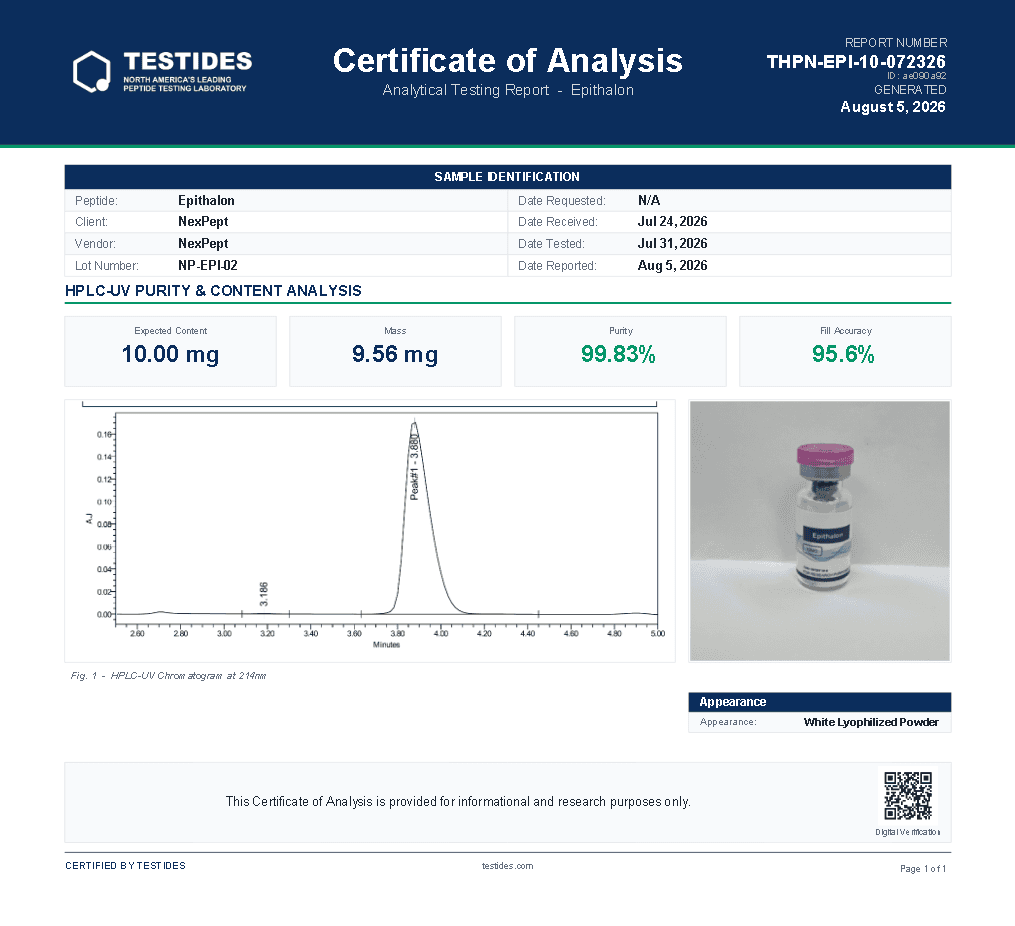
Independently tested for identity and purity
NP-EPI-02
Aug 5, 2026
99.83%
View Certificate of Analysis
CAS# 307297-39-8
Also Known As Epithalon; AEDG Tetrapeptide
Class Synthetic Pineal Tetrapeptide / Telomerase Research Tool
Form Lyophilized Powder
Research Targets
Peptide Length
Molecular Weight
Epitalon (CAS# 307297-39-8) is a synthetic tetrapeptide with the sequence Ala-Glu-Asp-Gly (AEDG), developed as a research analogue of Epithalamin — a polypeptide extract isolated from the bovine pineal gland. It is studied in cell biology models examining telomerase activity, TERT (telomeric reverse transcriptase) gene expression, cell cycle regulation, and neuroendocrine signalling pathways associated with the pineal gland. As the shortest characterised peptide with documented telomere-related activity in preclinical models, Epitalon occupies a unique position in the in vitro research literature on replicative senescence and chromosomal stability. Supplied by NexPept as a lyophilized powder for in vitro laboratory research use. This compound has not been authorized by Health Canada for any therapeutic, clinical, or human use.
Molecular Profile
CAS#, AEDG sequence, molecular formula, pineal origin, analytical data
CAS#, AEDG sequence, molecular formula, pineal origin, analytical data
| Property | Value |
|---|---|
| CAS Number | 307297-39-8 |
| Research Designation | Epitalon; Epithalon; AEDG tetrapeptide |
| Compound Class | Synthetic pineal tetrapeptide — telomerase research tool compound |
| Full Sequence (3-letter) | Ala-Glu-Asp-Gly |
| Full Sequence (1-letter) | AEDG |
| Sequence Length | 4 amino acids (tetrapeptide) |
| Molecular Formula | C₁₄H₂₀N₄O₁₀ |
| Molecular Weight | ~390.3 Da |
| Biological Origin | Synthetic analogue of Epithalamin — polypeptide fraction from bovine pineal gland extract (Khavinson et al.) |
| Primary Research Targets | TERT (telomerase reverse transcriptase); p53 / p21 cell cycle axis; pineal neuroendocrine signalling |
| Physical Form | Lyophilized powder |
| Analytical Method | High-Performance Liquid Chromatography (HPLC) + Mass Spectrometry (MS) |
| Appearance | White to off-white lyophilized solid |
| Purity | ≥98% (HPLC); verify against batch CoA |
In Vitro Research Context
Telomerase biology, cell cycle regulation & neuroendocrine models — laboratory use only
Telomerase biology, cell cycle regulation & neuroendocrine models — laboratory use only
The primary mechanistic focus of Epitalon research is its documented upregulation of TERT (telomerase reverse transcriptase) mRNA and protein expression in somatic cell models. Telomerase — the ribonucleoprotein complex comprising TERT and the RNA template component TERC — extends telomeric repeat sequences (TTAGGGₙ) at chromosomal ends, counteracting replicative shortening. In normal somatic cells, TERT is transcriptionally silenced, linking successive cell divisions to progressive telomere attrition and eventual replicative senescence. Published in vitro studies using Epitalon in human fetal fibroblast and epithelial cell preparations have reported TERT mRNA upregulation and associated increases in telomerase enzymatic activity (measured by TRAP assay), positioning the peptide as a tool compound for studying the transcriptional regulation of telomerase in non-immortalised somatic cell lines. These findings are from cell culture models and do not constitute evidence of in vivo efficacy.
Epitalon is used as a tool compound in TRAP (Telomeric Repeat Amplification Protocol) assays to assess telomerase enzymatic activity in cell lysates, and in qRT-PCR and western blot experiments examining TERT mRNA and protein expression in somatic and primary cell preparations.
Epitalon is studied in replicative senescence assays (SA-β-galactosidase staining, cell passage models) and in experiments examining p53/p21 pathway activation — the downstream effectors linking short telomeres to cell cycle arrest in the G1 phase of primary fibroblast and epithelial cell models.
As a synthetic analogue of pineal peptide extract Epithalamin, Epitalon is studied in neuroendocrine cell models examining pineal signalling pathway interactions, melatonin biosynthesis regulation, and the relationship between pineal peptide fractions and circadian/hypothalamic signalling cascades.
Published in vitro work includes Epitalon studies in oxidative stress assays examining superoxide dismutase (SOD) and catalase activity, lipid peroxidation markers (MDA/TBARS), and ROS production in cell preparations — mechanistically linked to the peptide’s proposed interactions with cellular stress response pathways.
Epitalon is notable for being the shortest peptide in the published literature with documented TERT-modulating activity in cell-based models. The AEDG tetrapeptide’s small size (390.3 Da) facilitates cell membrane penetration in culture conditions without requiring delivery vectors, simplifying in vitro experimental design. Its origin as a fraction of the pineal gland extract Epithalamin connects it to the broader research field of peptide bioregulators (cytomedins) developed from organ-specific polypeptide fractions — a research tradition with an extensive published literature primarily originating from the St. Petersburg Institute of Bioregulation and Gerontology.
Research context: Epitalon is an investigational synthetic tetrapeptide studied in scientific research involving telomerase biology, TERT gene expression, cell cycle regulation, and neuroendocrine signalling models. It has not been authorized by Health Canada for human or veterinary use.
Available Formats
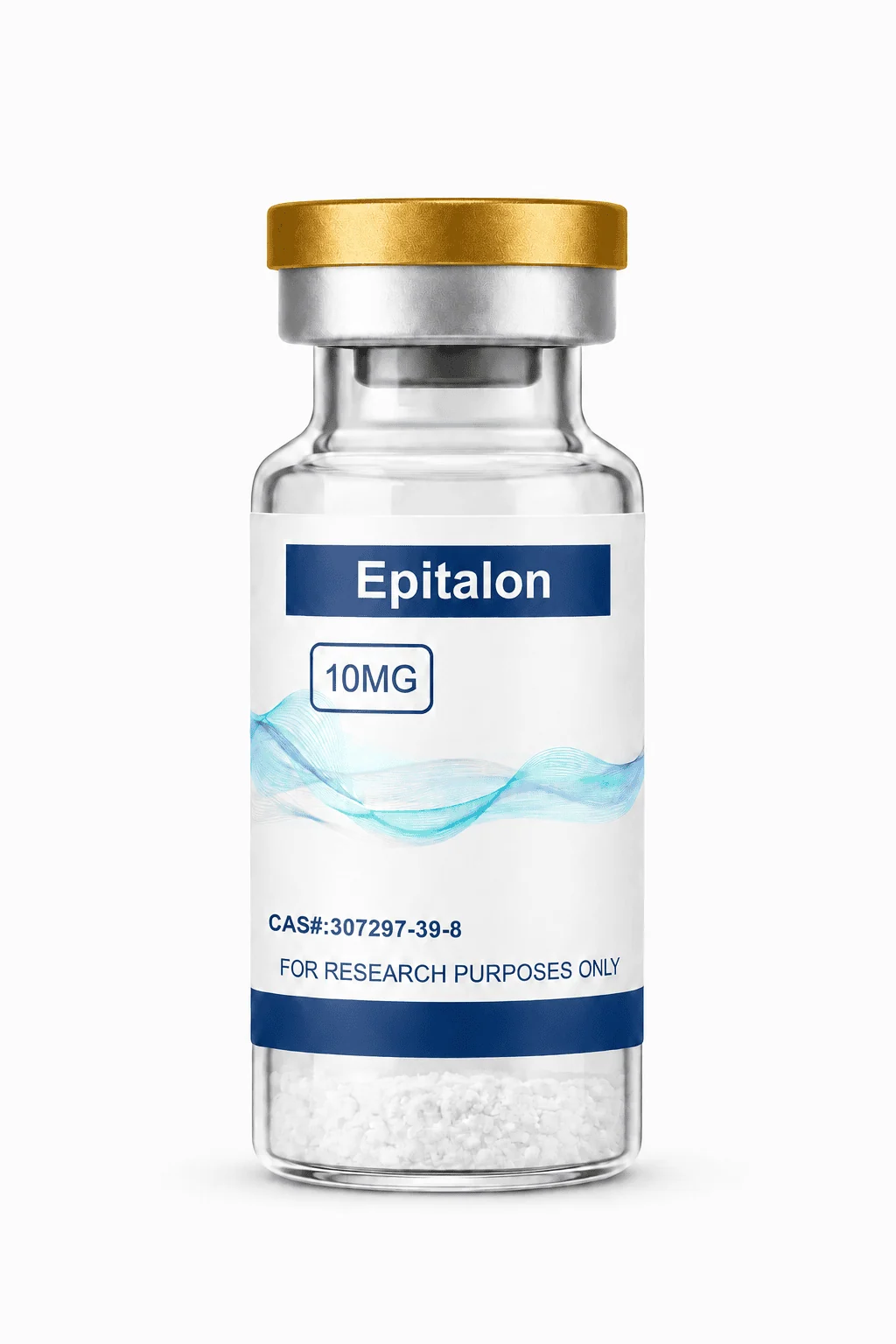
10 mg — lyophilized powder
10 mg — lyophilized powder
| Format | Net Quantity | Physical Form |
|---|---|---|
| Epitalon 10mg | 10 mg / vial | Lyophilized powder |
Sourced from a verified batch. Quantity for use should be determined based on your specific in vitro research protocol by qualified research personnel.
Laboratory Storage
Controlled storage conditions for lyophilized material
Controlled storage conditions for lyophilized material
Store sealed lyophilized material under controlled laboratory conditions in accordance with validated institutional SOPs and applicable technical documentation. Protect from light and moisture. As a short tetrapeptide (4 AA, 390.3 Da) composed entirely of non-aromatic, non-sulphur-containing residues (Ala, Glu, Asp, Gly), Epitalon has a favourable chemical stability profile in the lyophilized state — the absence of Met, Trp, Cys, and His eliminates the most common oxidative and metal-coordination degradation pathways seen in larger research peptides. The Asp and Glu residues may undergo acid-catalysed hydrolysis under prolonged storage in aqueous solution; lyophilized material should be kept sealed until use. Reconstituted aliquots should be stored at −20 °C and used promptly to avoid hydrolytic degradation of the peptide backbone.
Note: No preparation, reconstitution, or administration instructions are provided. This compound is supplied for in vitro laboratory research use only. All handling must be conducted by qualified personnel following institutional safety protocols.
Research Literature
Scientific references & related resources
Scientific references & related resources
Epitalon Research Peptide Overview — NexPept compound overview and in vitro research context
PubMed — Epitalon / Epithalon Telomerase Research — peer-reviewed literature on TERT expression, telomere length modulation, and cell senescence models
PubMed — Khavinson Pineal Peptide Bioregulator Research — foundational literature on peptide bioregulators and pineal gland extract fractions
Research Peptides in Canada — sourcing and research context for Canadian laboratories
What Are Research Peptides? — peptide classification and in vitro research context
This product is supplied exclusively for in vitro laboratory and non-clinical research use by qualified research personnel. It is not authorized by Health Canada for human or veterinary use. No therapeutic, clinical, or health claims are made.
This material must not be administered to humans or animals. No dosage, preparation, reconstitution, or administration instructions are provided or implied. All handling and use must be conducted by qualified personnel in accordance with applicable institutional policies and legal requirements.
Be the first to review “EPITALON 10MG”
Related products

Reviews
There are no reviews yet.